Children learn to read by developing five skills: phonemic awareness, phonics, vocabulary, fluency, and comprehension (National Reading Panel, 2000). These build in sequence: a child first hears that words are made of sounds, then maps those sounds to letters, then reads whole words, and finally reads sentences with meaning. ASER reports that fewer than half of Class 5 children in rural India can read a Class 2 level text. One of the most useful things a parent can do is have your child read aloud to you for 10–15 minutes a day, every day, helping with tricky words. Reading aloud helps turn phonics knowledge into fluency, because the child applies every sound in real context while an adult, or an AI reading coach, catches and corrects errors on the spot. Levelled picture books read together give practice in several of these skills at once.
- Reading has 5 core skills: phonemic awareness, phonics, fluency, vocabulary, and comprehension — all must develop together.
- Most children are developmentally ready for structured reading teaching between ages 4 and 6.
- Having your child read aloud to you every day, with your help on tricky words, is one of the most useful things families can do at home.
Your child reads a storybook out loud. ZigZu listens to every word, teaches the ones they miss, and they try again. 100+ storybooks, set to the words your child can read.
Try ZigZu freeAndroid and iPhone · 100+ storybooks · No ads
The 5 Key Skills Children Need to Read
Researchers describe five essential skills that help children become strong readers.
The ability to hear individual sounds in spoken words. The word "dog" contains three sounds: d, o, g. Children who can hear these sounds find it easier to connect them to letters.
Teaches children how letters represent sounds. m→muh, a→ah, t→tuh → blend: mat. See our phonics for beginners guide for more details.
The number of words children understand. Built through listening, hearing stories, and reading books. Strong vocabulary helps children understand what they read.
Fluent readers read smoothly without stopping at every word. Develops through regular reading practice. See our reading practice for kids guide to build this skill.
Understanding what a story means. Children improve by talking about stories, answering questions, and predicting what happens next.
The Simple View of Reading: why phonics alone is not enough
The most important equation in reading science was proposed by Gough and Tunmer in 1986:
This is called the Simple View of Reading. It explains why children who can decode words fluently (they sound out letters correctly) can still fail to understand what they read — because if language comprehension is weak, the product of the equation is still low.
For Indian parents, this has a practical implication: phonics practice (decoding) is necessary but not enough. A child also needs vocabulary, listening comprehension, and the ability to understand connected ideas — skills built through conversation, storytelling, and hearing English used in context.
Separately, the National Reading Panel's 2000 report reviewed the research on five parts of reading: phonemic awareness, phonics, vocabulary, fluency, and comprehension. Teaching that covers all five, not just phonics, is the well-supported approach.
Phonemic Awareness
Phonemic awareness is the foundation of all reading development. It's the ability to hear, identify, and work with individual sounds in spoken words.
For example, a child with phonemic awareness can identify that the word "cat" contains three distinct sounds: c (kuh), a (ah), and t (t).
Before children can learn phonics, they need phonemic awareness. Once they can hear sounds clearly, connecting those sounds to letters becomes much easier.
Phonics
Phonics is the method of connecting letters with sounds so children can decode words on their own.
Here's a simple example:
Once children understand this system, they can read many words they have never seen before.
Vocabulary and Reading Fluency
Vocabulary is the collection of words a child understands. Children with strong vocabulary comprehend stories better.
Reading fluency means reading smoothly and automatically, without pausing at every word. Fluent readers understand what they read because they're not struggling with decoding every single word.
Both skills improve through consistent reading practice and exposure to stories.
The Stages of Learning to Read
Stage 1 — Listening and Language Development
Listening to stories, hearing conversations, learning new words. Builds foundation.
Stage 2 — Recognising Letters and Sounds
Learning alphabet letters + letter sounds. b→buh, s→s.
Stage 3 — Blending Sounds Into Words
s→s, u→uh, n→n → sun. Blending helps children read simple words on their own.
Stage 4 — Reading Simple Sentences
"The dog runs fast." Builds confidence.
Stage 5 — Reading Stories Independently
Improve reading speed, pronunciation, and comprehension.
Why Some Children Learn to Read Faster
Children learn at different speeds. Several factors influence reading development. Children often learn faster when they have:
- regular exposure to books
- phonics practice
- opportunities to read aloud
- encouragement from parents
Daily reading practice helps children build these skills gradually.
Why Phonics Is Important for Learning to Read
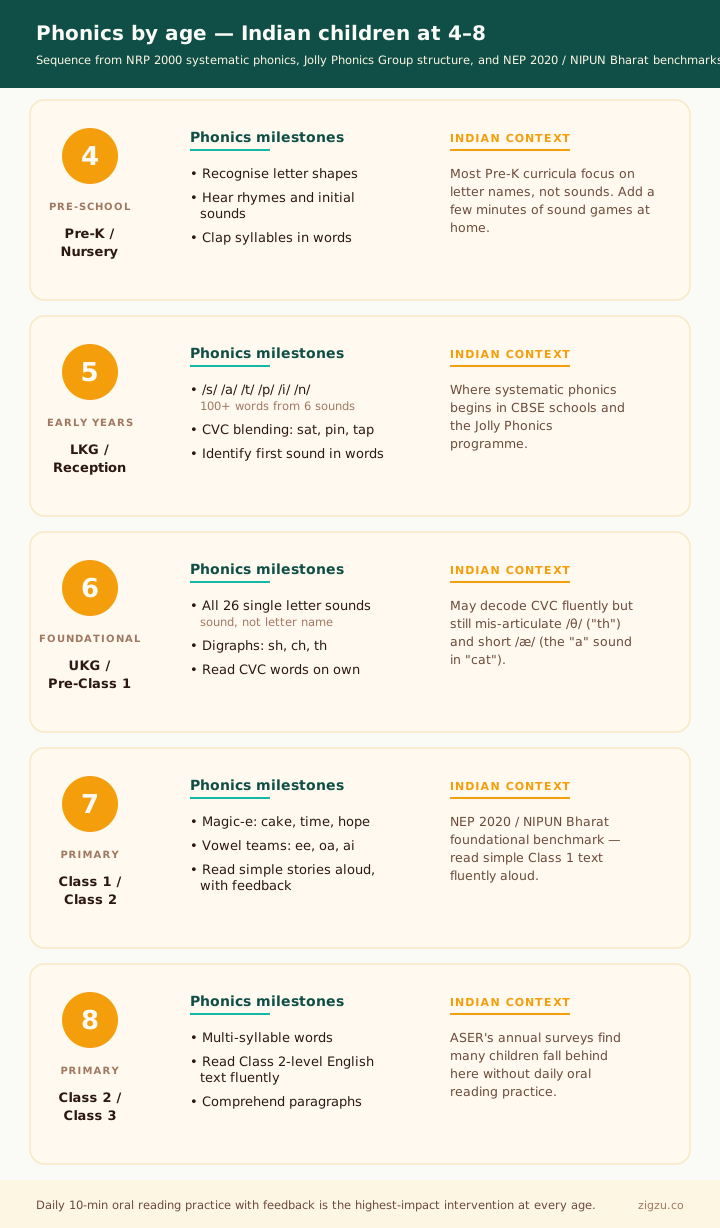
Phonics helps children understand how words are built from sounds. Instead of memorising, they learn to decode. Begin with the 26 alphabet sounds, then move on to blending them into words.
Phonics gives children a reliable method for reading new words.
You can also explore our phonics activities for kids to make phonics practice more engaging.
How Reading Practice Improves Reading Skills
Reading improves with consistent practice. Children who read regularly develop stronger vocabulary, fluency, and comprehension.
Reading aloud is especially helpful for beginner readers. When children read aloud, they practise pronunciation, sentence rhythm, and word recognition.
You can explore our English speaking practice for kids guide to help strengthen communication skills.
Simple Ways Parents Can Help Children Learn to Read
Parents play an important role in supporting reading development.
Daily Activities to Try at Home
Read With Your Child Every Day
Even 10–15 minutes of daily reading can make a big difference. Take turns reading sentences with your child.
Ask Questions About the Story
After reading, ask: "What happened in the story?", "Who was the main character?", "What do you think will happen next?" This helps children understand what they read.
Encourage Reading Aloud
Reading aloud improves pronunciation and reading fluency. It also helps children develop speaking confidence.
Make Reading Fun
Choose stories that match your child's interests. Children are more motivated when stories feel enjoyable.
Daily Reading Routine
| Activity | Time |
|---|---|
| Phonics review | 5 minutes |
| Reading aloud | 10 minutes |
| Story discussion | 5 minutes |
Choose books that match your child's reading level. Stories that are too difficult can discourage children. Pick books your child can mostly read, with a little help on a few words.
Common Mistakes Parents Make
Learning to read takes time and patience. Consistency matters more than speed.
Children should learn to decode words using phonics, not just memorise them.
Short daily reading sessions are more effective than occasional long sessions.
Signs Your Child Is Learning to Read
- recognises letter sounds quickly
- blends sounds into simple words
- reads sentences more smoothly
- talks about stories they read
How Indian children learn to read English
Reading development in India happens in a multilingual context that most Western reading research doesn't fully account for. Most Indian children are already learning to read in their regional language or Hindi when they begin English reading — which can be both an advantage (they understand what reading is) and a challenge (English letter-sound relationships are different). According to ASER's 2023 survey, 42% of children aged 14–18 in rural India still cannot read easy English sentences. And of those who can, only about 73.5% are able to explain what the sentence means. Decoding words correctly is not the same as understanding them, which is exactly what the Simple View of Reading above predicts.
Traditional Indian school methods often focus on sight-word memorising and copying: children learn to recognise whole words rather than decode them sound by sound. This works up to a point but breaks down when children encounter new, new words. A phonics foundation, combined with exposure to English stories, helps children build the decoding skills that textbook rote learning misses.
The phonics vs. rote memorisation contrast is especially stark in India: children who learn to read by rote can copy correctly but cannot decode a new word they have never seen before. Rote learning can produce the appearance of reading without the underlying decoding skill, and it may be part of why ASER finds so many Class 5 children still struggling with basic texts. Children who receive phonics teaching, by contrast, develop a transferable toolkit that works on any new word.
How ZigZu Helps Children Practise Reading
At ZigZu, we built our reading app around one simple idea: Children improve when they read aloud regularly.
- The child reads aloud
- ZigZu listens carefully
- ZigZu helps with difficult words
- The child improves gradually
Because ZigZu listens patiently, children can practise reading without fear of making mistakes. Over time, this builds reading confidence and fluency.
Frequently asked questions about how kids learn to read
Most children begin developing early reading skills between ages 4 and 6. Pre-reading skills — recognising letters, hearing rhymes, understanding that text carries meaning — start even earlier, from age 2 or 3. Formal reading teaching usually begins in nursery or reception at age 4–5. But children develop at different rates, and a child who starts reading at 6 can still make good progress with consistent support.
Yes, phonics is the most evidence-backed method for teaching reading. It gives children a reliable system to decode any word they encounter, rather than memorising a fixed set of words. The National Reading Panel's research and decades of follow-up studies regularly show that systematic phonics teaching produces stronger reading outcomes than whole-language approaches, including for children learning English as a second language.
Fifteen to twenty minutes of daily reading practice is a sensible target for most children. The quality of practice matters as much as the duration — reading aloud with a parent who discusses the text produces better outcomes than silent reading for the same time. Reading on weekends and holidays as well as school days keeps the habit going.
For beginner readers ages 4–7, reading aloud is more useful than reading silently. Reading aloud while an adult listens and helps has the clearest evidence for building smooth reading (National Reading Panel, 2000), and it lets you hear where a child is struggling and help straight away. Silent reading on its own hasn't been shown to build fluency; it becomes more useful once a child reads smoothly on their own. Until then, every reading session should include at least some read-aloud practice.
Start by identifying whether the difficulty is with recognising letters, blending sounds, or reading fluency. If a child cannot blend simple three-letter words like 'cat' or 'sit,' go back to phonics basics first. Choose books one level below the child's current level to rebuild confidence. Keep sessions short, positive, and pressure-free — reading is easier to come back to when it doesn't feel like a test.
Teach letter sounds first, then add letter names once your child blends simple words. Sounds are what reading actually uses: 'c-a-t' becomes 'cat', while the names 'see-ay-tee' do not. Start with the sounds s, a, t, p, i, n, because they build many short words quickly. Keep the sounds short and clipped, saying 'mmm' rather than 'muh', so blending stays clean. Letter names can come later, alongside the alphabet song and writing.
Want your child to read English with confidence?
ZigZu listens while your child reads stories aloud and helps them improve step by step. Free to start — download today on Play Store or App Store.
Download ZigZu, Free AI Reading CoachFree to download on Android and iOS. No card needed to start.