Phonics is the method of teaching reading by connecting letters to the sounds they make, so a child can decode a word they have never seen before instead of memorising thousands of them by shape. A child learns that c says "kuh," a says "ah," and t says "t," then blends those three sounds into cat. The National Reading Panel's 2000 review found systematic phonics to be the most effective way to teach early reading.
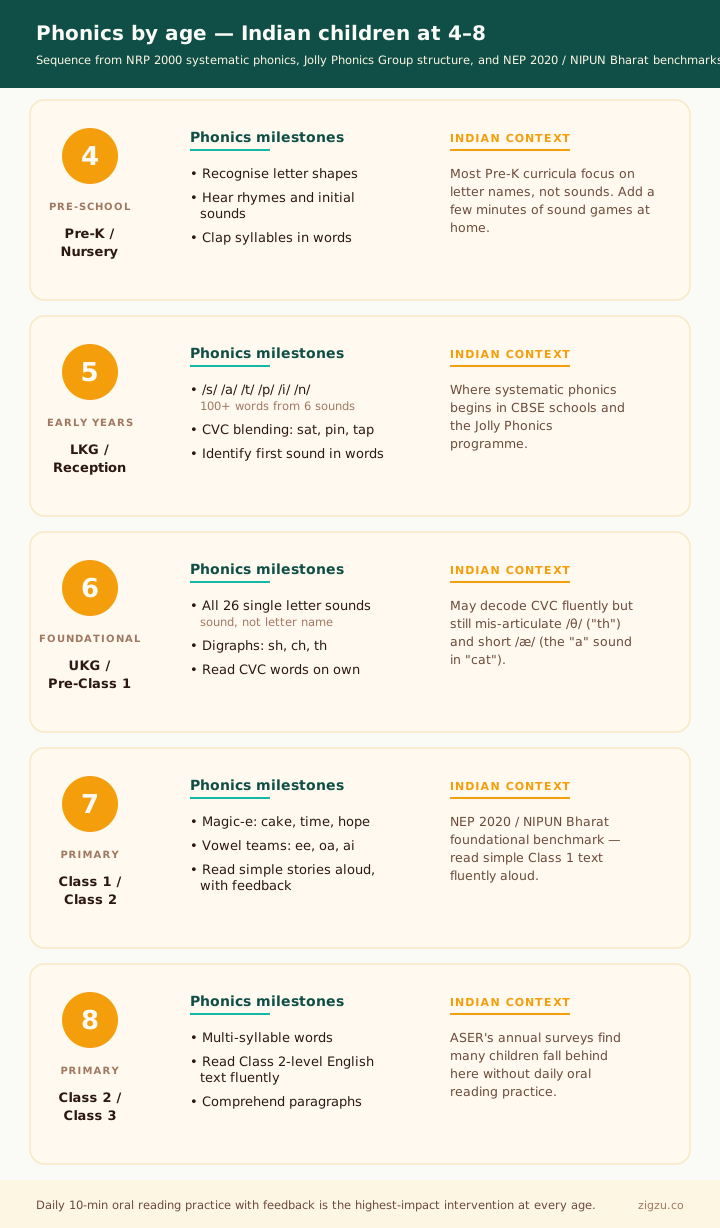
Start with the six sounds s, a, t, p, i, n, which already build dozens of real words, then add the second group: c, k, e, h, r, m, d. Teach letter sounds before letter names, because knowing that s says "sss" is what unlocks reading, while knowing it is called "ess" is not. Most children aged 4 to 6 are ready, and 10 to 15 minutes of daily practice beats longer sessions two or three times a week.
- Start with the s-a-t-p-i-n sequence — these 6 letters make dozens of real words children can blend within days.
- 10–15 minutes of daily phonics practice outperforms longer sessions 2–3 times a week (National Reading Panel, 2000).
- Teach letter sounds before letter names — knowing that "s" says "sss" is what unlocks reading; knowing it is called "ess" is not.
It is hard to tell by ear. ZigZu listens while your child reads a storybook aloud, spots the words they say wrong, and teaches those sounds right there, in Indian English.
Try ZigZu freeAndroid and iPhone · 100+ storybooks · No ads
Phonics is the foundation of reading
Phonics teaches children how letters make sounds, so they can read words on their own instead of memorising thousands of them. Children learn the sound each letter makes, then practise blending those sounds together to decode new words. For example:
Once children understand this system, they can read words they have never seen before. That is why phonics is considered the foundation of early reading. At ZigZu, we listen to thousands of children reading aloud every week, and one pattern appears again and again: many children struggle because they try to guess words instead of sounding them out.
Children who learn phonics early often become more confident readers.
In this guide you'll learn what phonics is, how to start teaching it, which sounds beginners learn first, which words children can practise, and a handful of simple activities you can do at home. If you're beginning your child's reading journey, you may also want to read our guide on helping your child learn English at home.
Where do you start with phonics for beginners?
Parents often wonder where to begin when teaching phonics.
A simple learning path looks like this.
Children first learn the sounds letters make.
Example sounds: s, a, t, i, p, n
These sounds combine easily to form simple words.
Next, children combine sounds to read simple words.
Blending is the key skill that allows children to start reading.
After blending sounds, children practise reading simple words such as: cat, pen, sun
These follow predictable phonics patterns.
Once children can read several words, they begin reading short sentences.
Example: "The cat sat."
This stage helps children build reading confidence.
Keep phonics practice short and fun. Even 10 minutes per day is enough to build strong reading foundations over time. If you are weighing up paid tuition instead, here is what phonics classes cost across Indian cities.
Why phonics is important for kids learning English
English contains thousands of words, and trying to memorise each one quickly becomes overwhelming for a young reader. Phonics gives children a system: instead of memorising words whole, they learn how words are constructed from sounds, which lets them attempt any new word they meet.
This helps children:
- read new words on their own
- improve pronunciation
- build reading confidence
- expand vocabulary faster
The National Reading Panel (2000), after reviewing decades of research, concluded that systematic phonics teaching produces much better reading outcomes than non-phonics approaches, particularly for children in the early stages of learning to read.
Phonics learning journey
Children usually progress through phonics learning in stages.
| Stage | What Children Learn |
|---|---|
| Stage 1 | Letter sounds (s, a, t) |
| Stage 2 | Blending sounds (sat) |
| Stage 3 | Reading CVC words |
| Stage 4 | Reading simple sentences |
This gradual progression helps children develop strong decoding skills.
What is on a phonics sounds chart for kids?
Children usually begin phonics by learning the sounds of individual letters. A phonics sound chart puts every one of them on a single page, grouped in the order they are taught rather than A to Z.
Here are some common phonics sounds beginners learn first.
| Letter | Example Word |
|---|---|
| s | sun |
| a | apple |
| t | tap |
| p | pen |
| i | igloo |
| n | net |
These sounds combine to form many beginner reading words.
Once children are confident with single letter sounds, most phonics programmes introduce a second group: c, k, e, h, r, m, d. These expand the word bank significantly — a child who knows both groups can read hundreds of simple English words. Once both groups are secure, work through all 26 alphabet sounds in order, so no letter is left to guesswork.
What are digraphs? (ch, sh, th, ck)
Once children are confident blending three-letter words (CVC words like cat, pin, sun), the next phonics step is digraphs — pairs of letters that together make a single sound.
The four digraphs children encounter most often in early reading:
| Digraph | Sound | Example words |
|---|---|---|
| ch | ch (as in chat) | chip, chin, chop, much |
| sh | sh (as in ship) | shop, fish, wish, shell |
| th | th (as in thin) | this, that, then, with |
| ck | k (as in kick) | back, duck, lock, thick |
Digraphs are particularly important for Indian children because the "th" sound does not exist in Hindi, Tamil, Telugu, or most other Indian languages. Children often substitute "d" for the voiced "th" (saying "dis" instead of "this") and "t" for the unvoiced "th" (saying "tink" instead of "think"). This is completely normal — it simply means the "th" digraph needs more practice than others.
A useful home activity: say a digraph word slowly, then ask your child to put their tongue gently between their teeth and say the "th" sound. The physical awareness of where the tongue goes makes the correction stick faster than repetition alone.
Phonics words for beginners
Once children know a few sounds, they can begin reading simple words.
Here are some phonics examples beginners can practise.
Simple CVC Words
Practising these words strengthens children's sound blending skills.
Phonics examples for kids
Breaking words into sounds helps children understand how phonics works.
| Word | Sound Breakdown |
|---|---|
| cat | c – a – t |
| sun | s – u – n |
| pen | p – e – n |
| hat | h – a – t |
These examples help children learn how sounds combine to form words.
What are CVC words?
CVC stands for:
- Consonant
- Vowel
- Consonant
These words follow simple sound patterns that are easy for beginner readers to decode.
Examples include:
CVC words are often the first words children learn to read on their own.
Teach letter sounds first, not letter names. Children need to know that "s" says "sss" before they learn its name. This small difference speeds up reading progress significantly.
Simple phonics activities for kids
Phonics works best when learning feels like a game.
Here are a few activities parents can try.
Activities to try at home
Sound Hunt Game
Choose a sound for the day.
Example: m
Ask your child to find objects that start with that sound.
- mango
- milk
- moon
Build Words With Letters
Use magnetic letters or paper cards.
Ask your child to build simple words like: cat, bat, sat
Changing one letter helps children understand how sounds create new words.
Clap the Sounds
Say a word slowly and clap each sound.
Example: cat → clap for c, a, t
This helps children recognise sounds inside words.
Daily phonics practice routine
Short daily practice works best.
A simple 10–15 minute routine might look like this:
Review 3 letter sounds — pick sounds your child has been learning
Read 5 CVC words — practise blending sounds together
Read 1 short sentence — builds reading confidence
Once children start reading words comfortably, adding regular reading practice for kids helps strengthen their skills.
Speaking words aloud also improves pronunciation, which is why many parents combine phonics with English speaking practice activities for kids.
If a child struggles with a word, allow them time to sound it out. Confidence grows when children solve reading challenges themselves — resist the urge to give the answer right away.
What are the most common phonics mistakes parents make?
Even though phonics is simple, a few mistakes can slow progress.
Children should first learn letter sounds, not just alphabet names.
Phonics takes time and repetition.
Consistency matters more than speed.
If a child struggles with a word, allow them time to sound it out.
Confidence grows when children solve reading challenges themselves.
Phonics for Indian children learning English
In India, most children grow up speaking Hindi, Tamil, Telugu, Marathi, or another regional language at home. When they begin learning English, they face a unique challenge: English sounds don't always match the sounds in their mother tongue. For example, there is no direct equivalent of the English "th" sound in most Indian languages, so children often substitute "d" or "t" instead.
Many Indian schools still rely on rote memorising: children learn to write and repeat words without understanding how the sounds connect to the letters. According to ASER's annual surveys, only about 24.5% of Class 5 children in rural India can read a simple English sentence, and that number has barely moved since 24.7% in 2016 despite years of the same rote approach. Phonics takes a different approach: it teaches children why words sound the way they do, which helps them decode new words on their own rather than memorising a fixed list.
For Indian children in CBSE, ICSE, or state board schools, building a strong phonics foundation in the early years (ages 4–7) means they can confidently read their English textbooks, answer questions in class, and develop vocabulary much faster than children who learned by rote alone.
How ZigZu helps children practise phonics
ZigZu is India's first AI Reading Coach. It hears every word your child reads, teaches what they miss, and does it in Indian English.
Children learn to read fastest when they read aloud daily and practise sounding out words themselves. Most homes do not have a patient adult available for 10 minutes every day to listen, prompt, and correct. ZigZu fills that gap.
When a child reads a ZigZu story:
- The child reads the sentence aloud
- ZigZu listens to every word
- If a word is mispronounced, ZigZu gently guides the child to the right sound
- The child tries again and moves on once it lands
Because ZigZu listens patiently and never rushes, children practise reading without the fear of making mistakes in front of a parent or teacher.
Start your child's phonics journey today
Phonics helps children understand how English words are built.
Once children master phonics, they can:
- decode new words on their own
- read stories confidently
- improve pronunciation
- expand vocabulary naturally
Even 10–15 minutes of phonics practice per day can make a significant difference.
Frequently asked questions about phonics
Most children are developmentally ready to begin phonics between ages 4 and 6. At this stage, they can hear individual sounds in words and connect them to letters. Starting earlier is fine for exposure — singing alphabet songs, for example — but structured phonics teaching usually begins in nursery or reception class. Following a child's interest and readiness matters more than hitting a fixed age.
The most widely used starting sequence is s, a, t, i, p, n — these six letters can be combined to make dozens of simple words like 'sat,' 'pin,' 'nap,' and 'tip.' This sequence is popular because children can begin blending real words within days of learning the first sounds. After these six, the next group is usually c, k, e, h, r, m, d.
English has about 44 phonemes — distinct speech sounds — but only 26 letters to represent them. This is why phonics can feel complex: many sounds are represented by two-letter combinations called digraphs, such as 'sh,' 'ch,' and 'th.' A child working through a systematic phonics programme will gradually learn all 44 sounds, usually over 2–3 years of structured practice starting at age 4.
Not necessarily, and many experts recommend starting with sounds before letter names. Knowing that the letter 's' makes the 'sss' sound is more useful for reading than knowing it is called 'ess.' Some programmes teach the alphabet song alongside phonics for familiarity, but the functional reading skill comes from knowing the sounds. If your child knows some letter names already, that is helpful but not a prerequisite.
They are closely related but not the same. Phonics moves from sound to letter — hearing a sound and knowing which letter or letters write it. Spelling moves from word to letters — knowing the conventional way to write a specific word. Phonics is the foundation; spelling refines it. A child with strong phonics can attempt any word, while spelling teaching polishes those attempts into standard written English.
Daily practice produces the best results. Research from structured phonics programmes regularly shows that 10–15 minutes every day outperforms longer sessions two or three times per week. Short, regular practice builds the neural pathways for sound-letter recognition more effectively than cramming. Even a 10-minute read-aloud session where a parent gently points out letter sounds counts as meaningful phonics practice.
No, 6 or 7 is not too late, and older beginners often move faster because they already know spoken English words. Start with the same s, a, t, i, p, n sequence, but move to blending and short books within a week or two instead of a month. Ten minutes a day of sounding out words in a real story, with mistakes corrected as they happen, usually closes the gap over a school year.
Want your child to practise phonics every day?
ZigZu listens while your child reads stories aloud and gently helps them sound out difficult words.
Start Reading with ZigZuFree to start. Available on Play Store and App Store.