Phonics sounds are the 44 distinct sounds (phonemes) in English, represented by single letters and by combinations like sh, th, ch, ai, and oo. Children learn to connect these sounds to letters so they can decode new words on their own, instead of memorising whole words by sight. The National Reading Panel (2000) identified systematic phonics, teaching the sounds in a deliberate sequence, as the most effective method for teaching children to read. English has only 26 letters for these 44 sounds, which is why children must learn letter combinations, not just the alphabet, to read and spell accurately. For Indian children, a handful of sounds need extra practice because they do not exist in Hindi, Tamil, or Telugu: the two "th" sounds, the v/w distinction, and short vowels like the /a/ in "cat" and the /u/ in "cup".
- English has 44 phonics sounds (phonemes) but only 26 letters — which is why children must learn digraphs like "sh," "th," and "ch" in addition to single letters (NRP, 2000).
- ASER's annual surveys regularly find that fewer than half of Indian Class 5 children in government schools read a Class 2 level text in their regional language fluently — a gap rooted in missing phonics teaching in early years.
- Indian children face three specific phonics sound challenges not seen in UK/US learners: th→t substitution, v/w confusion, and short vowel differences — all traceable to their mother tongue's sound system (ASER).
What are phonics sounds?
A phonics sound is the smallest unit of sound in spoken English — called a phoneme. English has about 44 phonemes, but only 26 letters to represent them.
This mismatch is why reading English is harder than reading languages like Hindi or Spanish, where each letter almost always makes one consistent sound. In English, the letter "a" alone makes a different sound in "cat," "cake," "car," and "was." Children need to learn which sound goes with which letter — and that's exactly what phonics teaches.
The 44 English phonics sounds fall into two main groups:
- Consonant sounds — sounds made by restricting airflow: /b/, /d/, /f/, /g/, /h/, /j/, /k/, /l/, /m/, /n/, /p/, /r/, /s/, /t/, /v/, /w/, /y/, /z/, /sh/, /ch/, /th/ (voiced), /th/ (unvoiced), /ng/, /zh/ (24 sounds)
- Vowel sounds — sounds made with open airflow: /æ/ (cat), /e/ (bed), /ɪ/ (sit), /ɒ/ (hot), /ʌ/ (cup), /ʊ/ (book), and 14 additional long vowels and diphthongs (20 sounds)
Children usually learn single-letter consonant and short vowel sounds first, then move to digraphs (two letters, one sound) and vowel teams as their reading confidence grows.
The National Reading Panel (2000) screened about 100,000 studies and found that step-by-step phonics works better than little or no phonics, especially in the early years.
For Indian parents, this matters because most children in India learn to read English by memorising words — not by learning the sound system. That's why so many children can read familiar words but struggle the moment they encounter a new one.
The complete phonics sounds chart — with Indian English notes
This chart covers all 44 English phonics sounds, in the order Indian children usually meet them across the first three years of reading teaching. The "Indian English Note" column flags where Indian children's mother-tongue sound system creates specific challenges. Tap any sound to hear it spoken aloud. If you want it on the wall rather than on screen, the printable phonics sound chart has the same sounds as free A4 sheets.
Single consonant sounds
| Letter(s) | Sound | Example Words | Indian English Note |
|---|---|---|---|
| b | bat, bed, bus | — | |
| c / k | cat, kick, cup | — | |
| d | dog, dig, mud | Indian retroflex /ɖ/ sounds slightly different but is close enough | |
| f | fan, fit, off | — | |
| g | get, big, gap | — | |
| h | hat, hop, him | — | |
| j | jam, jet, jug | — | |
| l | lip, let, hill | Indian /l/ is more dental; generally fine | |
| m | man, map, him | — | |
| n | nap, net, run | — | |
| p | pin, pet, tap | — | |
| r | run, red, car | Watch Indian retroflex /r/ is different from English approximant /r/ — intelligible but noticeable | |
| s | sun, sit, bus | — | |
| t | tap, ten, bat | Indian retroflex /ʈ/ sounds slightly different but is understood | |
| v | van, vet, give | Hard Often said as /w/ — "wery" for "very." Hindi/Tamil lack the labiodental /v/ | |
| w | win, wet, we | Hard Often said as /v/ — "ven" for "when." Reverse of the v/w confusion | |
| x | fox, box, mix | — | |
| y | yes, yam, yet | — | |
| z | zip, zap, buzz | — |
It is hard to tell by ear, especially sounds like th and v. ZigZu listens while your child reads a storybook aloud, spots the words they say wrong, and teaches those sounds right there.
Android and iPhone · Ages 4 to 8 · No ads
Consonant digraphs (two letters, one sound)
| Digraph | Sound | Example Words | Indian English Note |
|---|---|---|---|
| sh | ship, fish, shop | — | |
| ch | chip, much, chin | — | |
| th (unvoiced) | thin, think, bath | Hardest Said as /t/ — "tink" for "think." No /θ/ in Hindi, Tamil, or Telugu | |
| th (voiced) | this, that, with | Hardest Said as /d/ — "dis" for "this." Requires explicit tongue-between-teeth practice | |
| ck | back, duck, lock | — | |
| ng | ring, song, long | Generally fine — nasal sounds exist across Indian languages | |
| wh | when, what, where | Watch Often said as /v/ by Hindi-background children | |
| ph | phone, photo | — |
Short vowel sounds
| Vowel | Sound | Example Words | Indian English Note |
|---|---|---|---|
| a | cat, bag, map | Hard Indian children often lengthen to /ɑː/ — "caat" for "cat." The short /æ/ has no direct equivalent in most Indian languages | |
| e | bed, pen, ten | Generally fine | |
| i | sit, pin, him | Generally fine | |
| o | hot, dog, box | Generally fine | |
| u | cup, run, bus | Watch Sometimes said as /ʊ/ — "coop" for "cup." A subtle but common Indian English marker |
Long vowel sounds and vowel teams
| Pattern | Sound | Example Words | Note |
|---|---|---|---|
| a_e | cake, name, lake | Magic 'e' — the silent 'e' makes the vowel say its name | |
| ai / ay | rain, day, sail | — | |
| ee / ea | feet, sea, clean | — | |
| i_e / igh | like, night, time | Magic 'e' again — the 'i' says its name | |
| oa / o_e | boat, home, goat | — | |
| oo | moon, food, cool | — | |
| oo | book, cook, look | Same spelling, different sound — common confusion point | |
| ou / ow | out, cow, shout | — | |
| oi / oy | oil, boy, coin | — | |
| er / ir / ur | her, bird, turn | Watch Indian English often adds an 'a' sound — "hera" for "her" |
R-controlled vowels, the schwa and /ʒ/ — the last seven sounds
These complete the 44. The schwa is the most common sound in English, and /ʒ/ is the rarest — but children meet both early, in words like "about" and "television".
| Pattern | Sound | Example Words | Note |
|---|---|---|---|
| ar | car, park, star | Indian English says the 'r' — "car" sounds like "kaar". Perfectly fine | |
| or / aw | for, corn, saw | — | |
| a / e (unstressed) | about, sofa, banana | Watch The schwa. Indian English often gives it full vowel value — "a-bout" instead of "uh-bout" | |
| ear / eer | ear, near, deer | — | |
| air / are | air, hair, care | — | |
| ure / our | pure, tour, cure | Often merges with /ɔː/ in modern English — "sure" said like "shore". Both are fine | |
| si / su / ge | television, measure, treasure | Watch Often said as /dʒ/ ("pleajure") or /z/ by Indian speakers — model the soft buzz |
Which phonics sounds do Indian children find hardest?
Most phonics guides are written for UK or US children. Indian children face a different set of challenges — shaped by the sounds their mother tongue does (and doesn't) contain.
Across Indian English learners, the same phoneme substitutions appear again and again — and they are highly predictable based on the child's mother tongue — a foundational pattern documented in the descriptive linguistics of Indian English (Wells, Accents of English, 1982; Sailaja, Indian English, 2009). The patterns below summarise the most common L1-interference cases in Indian English.
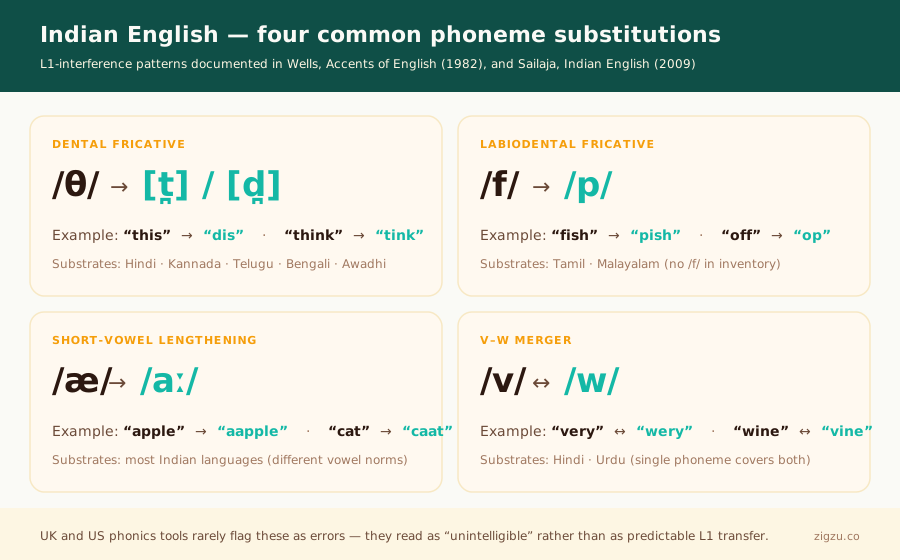
What we hear: "tink" instead of "think" · "dat" instead of "that" · "wid" instead of "with"
Why it happens: The dental fricatives /θ/ and /ð/ do not exist in Hindi, Tamil, Telugu, Marathi, or Gujarati. Children have never physically made this sound — the tongue-between-the-teeth position feels unnatural.
How to fix it: Ask your child to gently place their tongue between their upper and lower teeth, then blow air out. Practice "th-th-th" as a sound, then build to "think," "that," "with." The physical anchor helps much more than repetition alone.
What we hear: "wery" instead of "very" · "wen" instead of "when" · "vater" instead of "water"
Why it happens: Hindi uses a sound that sits between English /v/ and /w/ — so children may substitute either way. The English /v/ (lower lip touching upper teeth) and /w/ (rounded lips, no tooth contact) are two distinct articulations that most Indian languages don't separate.
How to fix it: For /v/ — bottom lip must touch upper teeth. For /w/ — round the lips like you're blowing a birthday candle. Practice minimal pairs: "vet/wet," "vine/wine," "very/wary."
What we hear: "caat" for "cat" · "baag" for "bag" · "maap" for "map"
Why it happens: Most Indian languages use a longer /ɑː/ vowel. The short, flat English /æ/ sound — as in "cat" — doesn't have a close equivalent. Children default to the familiar long vowel.
How to fix it: Practice the short /æ/ as a quick, clipped sound — "cat" said in one beat, never two. Contrast "cat/cart," "bag/bar," "tap/tar" to help children feel the length difference.
What we hear: An Indian retroflex /r/ where English uses an approximant. Most intelligible but marks strong Indian accent in read-aloud.
Why it happens: Indian languages use a rolled or tapped /r/ — the tongue touches the roof of the mouth. English /r/ is made with the tongue curled back but not touching anything.
How to fix it: For young learners (ages 4–7), do not prioritise this over the th/v/w errors above. Indian English /r/ is understood and accepted. Correct it only after the higher-priority sounds are secure.
ZigZu's speech recognition model is trained on Indian English pronunciation patterns — it understands the difference between a phonics error and an Indian English accent. It catches "tink" for "think" because that is a phonics error. It does not flag an Indian /r/ as wrong.
How to teach phonics sounds at home
Most Indian parents did not learn phonics themselves — they learned to read English by memorising words. If you are starting from scratch, this 5-step sequence will take you from zero to a child who can decode new words on their own.
This specific sequence is used in Jolly Phonics and most structured phonics programmes in Indian private schools. These six letters can be combined into dozens of real words right away — sat, sit, pit, pan, nip, tan — which gives children instant reading success.
Introduce one new sound every 2–3 days. Do not rush to the alphabet. Six sounds done well beats 26 sounds done poorly.
When you show the letter "s," say "sss" — not "ess." When you show "t," say "t" — not "tee." Letter names come later. The sound is what lets children read.
A useful check: hold up any letter card and ask your child "What sound does this make?" — not "What is this letter called?"
Once your child knows 3 sounds (/s/, /a/, /t/), show them how to push the sounds together: "s-a-t... sat." This is called blending, and it is the core reading skill.
Say each sound separately, then gradually speed up until the word is clear. Children often need 20–30 attempts at blending before it clicks — be patient.
After the first six sounds, add: c/k, e, h, r, m, d. Then the second group: g, o, u, l, f, b. By this point your child can read hundreds of simple words.
When single-letter sounds are secure, introduce digraphs: "sh," "ch," "th" (unvoiced), "ck." Digraphs unlock the rest of English reading — and "th" in particular needs extra practice for Indian children. Our printable phonics worksheets for LKG and UKG work through these in order, one page at a time, with the answer key published alongside so you can check without second-guessing yourself.
Phonics practice on their own is not enough. Children need to apply phonics sounds in real reading — sentences with context, pictures, and stories that hold their interest.
Ten minutes of daily read-aloud, where you occasionally pause and ask "Can you sound that word out?" is more effective than longer sessions twice a week. Consistency beats intensity.
You do not need to master phonics before teaching it. Learn one sound ahead of your child. If you're unsure of a sound, say "Let's figure it out together" — that models reading curiosity, which is exactly what you want.
Phonics sounds by age — what to expect at 4, 5, 6, 7, 8
Every child develops at their own pace, but this chart gives a reliable target for what phonics sounds children are usually ready to learn at each age.
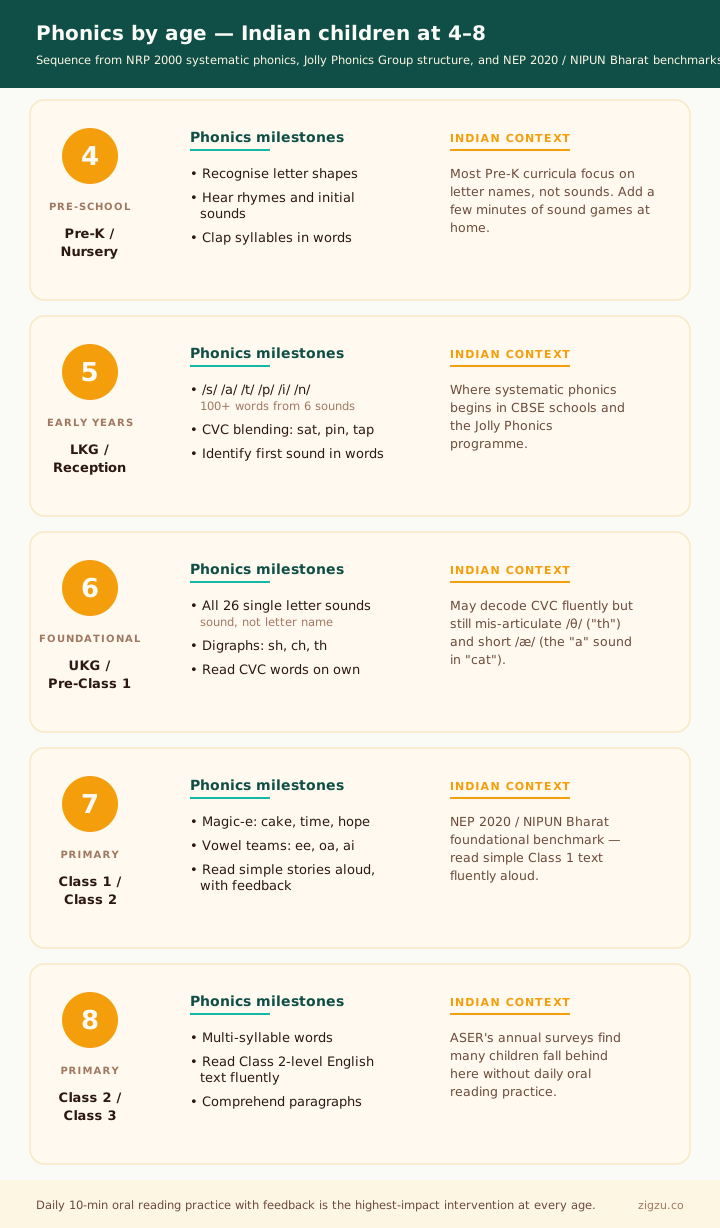
| Age | Phonics milestone | What parents can do |
|---|---|---|
| Age 4 | First 6 sounds (s, a, t, i, p, n). Blending 2–3 sounds into simple words. Recognising some letters by sight. | Keep it playful. Sound games, songs, and letter cards. 5–10 minutes daily is plenty. |
| Age 5 | 12–18 sounds learned. Reading simple 3-letter (CVC) words: cat, pin, sun. Starting to read short sentences: "The cat sat." | Add a decodable storybook to the routine. Point to words as you read. Ask "Can you sound that one out?" |
| Age 6 | All 26 single-letter sounds secure. Digraphs introduced: sh, ch, th, ck. Reading 4–5 word sentences on their own. | Focus on the "th" sound with extra practice. Introduce Jolly Phonics workbooks or structured storybook series, or start our free Class 1 English worksheets. |
| Age 7 | Vowel teams (ai, oa, ee). Long vowel patterns (magic 'e': cake, home). Reading short paragraphs with familiar words. | Read aloud together daily. When your child gets stuck, count to 5 before helping — let them try first. This is the age the Class 2 English worksheets are pitched at. |
| Age 8 | Full phonics map largely complete. Focus shifts to reading fluency and comprehension. Encountering multi-syllable words. | Move toward independent reading with support. Discuss stories — what happened, why, how characters felt. Our Class 2 reading comprehension passages ask exactly those questions. |
If your child is behind these targets, that is very common in India. ASER's annual surveys regularly document that fewer than half of Class 5 children in government schools read a Class 2 level text fluently — which means millions of Indian children are learning to catch up at age 8, 9, and 10. Starting systematic phonics at any age works, even if the child is older than the standard starting point. If you want material to practise with, all of it is free: 46 printable English grammar worksheets for Class 1 and Class 2, every one a single page with its answer key published alongside.
ZigZu listens to every phonics sound your child attempts — and teaches what they miss
Most phonics resources show children sounds. ZigZu goes further: it hears every word your child reads aloud and catches pronunciation errors in real time.
When a child reads "think" and says "tink," ZigZu catches it. When they say "wery" for "very," ZigZu catches it. Then it teaches the correct sound — not by telling, but by guiding the child to try again.
- Listens to your child read aloud from 100+ Indian-context storybooks
- Catches Indian English phonics errors that UK/US speech models miss entirely
- Teaches the correct phonics sound in real time — warm, not shaming
- Tracks which sounds each child struggles with and revisits them
- Works in Indian English — "wery," "tink," and short vowel errors are all on its radar
Hears every word your child reads. Teaches what they miss. In Indian English.
Available on Android and iOS · Free to start · Built for Indian English · No ads
India policy context: NEP 2020 and the ASER reading crisis
ASER's annual surveys sample hundreds of thousands of children across rural India each year. The reading crisis they document is not a failure of student ability — it is a failure of early reading teaching. Most Indian schools still teach English through memorisation and rote repetition, without a systematic phonics programme.
The National Education Policy 2020 (NEP 2020) directly addresses this. NEP 2020 mandates foundational literacy and numeracy as the highest priority of the school system, with a specific goal of achieving universal basic literacy by Class 3. The policy endorses systematic, explicit phonics teaching as part of early language education — a significant shift from India's traditional sight-word approach.
Cities with the highest parental demand for phonics resources, based on search volume data:
| City | Monthly phonics searches | What parents are looking for |
|---|---|---|
| Delhi NCR | 8,870/month | Phonics tutors, phonics worksheets, Jolly Phonics centres |
| Bangalore | 6,340/month | English-medium school readiness, phonics apps |
| Chennai | 6,010/month | Phonics for Tamil-background children, th/v/w errors |
| Mumbai | 5,200/month | Phonics tuition, reading level assessment |
| Hyderabad | 4,800/month | Telugu-background phonics teaching, CBSE readiness |
Indian parents are searching for phonics help in record numbers — not because it's a trend, but because they are seeing the gap in their children's reading confidence and want to close it.
The good news: phonics sounds can be taught at any age. A child who is 7 or 8 and has never had systematic phonics teaching can make rapid progress with 10–15 minutes of daily practice. The sounds don't change — only the starting point does.
Frequently asked questions about phonics sounds
Phonics sounds are the individual sounds that letters and letter combinations make in English. There are 44 phonemes — distinct sounds — but only 26 letters to represent them. Children learn these sounds systematically to decode new words on their own. The National Reading Panel (2000) identified phonics as the most effective approach to early reading teaching.
English has 44 phonemes — the individual sounds that make up spoken English — represented by 26 letters and about 120 letter combinations. Because there are more sounds than letters, two-letter combinations called digraphs (sh, ch, th, ck) and vowel teams (ai, oa, ee) are used to represent additional sounds. Most systematic phonics programmes teach all 44 sounds over two to three years.
The three most common phonics struggles for Indian children are: the "th" sound (children say "tink" instead of "think"), the "v" and "w" distinction (children say "wery" for "very"), and short vowel sounds like the short /æ/ in "cat." These substitutions happen because most Indian languages — Hindi, Tamil, Telugu — do not contain these specific sounds, so children must learn them clearly.
A letter name is what we call the letter — "bee," "cee," "dee." A phonics sound is what the letter says when we read — /b/, /k/, /d/. Children need letter sounds, not names, to read. Knowing "s" is called "ess" does not help a child read "sun." Knowing "s" says /s/ does. Most phonics programmes teach sounds from the start, introducing letter names only later.
Yes. Most parents in India did not learn phonics — they learned to read by memorisation. You do not need phonics training to support your child. Start with six sounds: /s/, /a/, /t/, /p/, /i/, /n/. Show your child each letter, say its sound clearly, then blend them into simple words: sat, pin, tap. Ten minutes daily is enough. ZigZu guides the sounds; your role is to listen alongside.
Yes, it matters, because the extra 'uh' breaks blending. A child who says 'buh-a-tuh' hears three chunks and cannot hear 'bat'. Say consonant sounds short and clipped, almost whispered, with no vowel after them: /b/, /t/, /k/. Practise by putting your hand in front of your mouth; a clean /t/ gives a small puff of air, 'tuh' gives a voice. Most children fix this within a week of clipped modelling.
Ready to help your child master every phonics sound?
ZigZu listens while your child reads aloud and catches every phonics error in real time — including the ones Indian children struggle with most.
Download ZigZu, Free AI Reading CoachAvailable on Android & iOS · Free to start · No credit card required