Phonics classes in Chennai for children aged 4–8 range from private tutors at ₹2,500–₹6,000 per month to online AI coaching free to start. Most Chennai CBSE and ICSE schools teach phonics from LKG — the gap is daily oral practice at home with real-time correction for Tamil phoneme interference.
- Chennai has a long tradition of English-medium schooling — many established CBSE and ICSE schools have taught phonics for over a decade, with NEP 2020 now mandating foundational literacy for all schools by Class 3 (NEP 2020).
- ASER found significant English reading gaps persist in Tamil Nadu despite urban school quality — pointing to insufficient daily practice, not classroom instruction, as the primary bottleneck.
- Tamil has no /f/, /z/, or dental fricative (/th/) sounds — Chennai children systematically substitute 'p' for 'f', 's' for 'z', and 't'/'d' for 'th', creating errors that UK and US phonics apps consistently miss or misclassify (ASER).
Phonics classes in Chennai — what's available
Chennai has one of India's strongest English-medium school traditions, with established CBSE and ICSE institutions delivering rigorous academic programmes for generations. Despite this, many Chennai parents still search for supplementary phonics support — because classroom instruction, however high-quality, is not the same as daily oral reading practice at home.
Private home tutors
In areas like Adyar, T. Nagar, Nungambakkam, Anna Nagar, and Velachery, English reading and phonics tutors charge ₹2,500 to ₹6,000 per month for two to three sessions per week. Chennai has a strong tutoring culture — many tutors are trained teachers or education graduates. However, even well-qualified tutors meet with each child two or three times per week at most, leaving four or five days with no reading practice.
Offline reading and phonics centres
Chennai has several dedicated reading and early learning centres, particularly in Adyar, Kilpauk, and OMR. Group sessions run ₹2,000–₹4,000 per month. The same frequency limitation applies: once-weekly sessions cannot build the phonics fluency that daily practice produces. A child attending a phonics centre every Saturday makes measurably slower progress than one reading aloud for 10 minutes every evening.
What Chennai schools already provide
Most reputable CBSE and ICSE schools in Chennai have taught phonics in LKG and UKG for at least a decade, well ahead of NEP 2020's mandate. Many of Chennai's established CBSE and ICSE schools use structured phonics curricula — often based on Jolly Phonics. The question for most Chennai parents is not whether phonics is being taught, but whether their child is practising it daily.
How much do phonics classes cost in Chennai?
| Option | Monthly cost | Sessions/week | Daily practice? | Indian English? |
|---|---|---|---|---|
| Private home tutor (Chennai) | ₹2,500–₹6,000 | 2–3 sessions | No | Varies by tutor |
| Offline reading centre | ₹2,000–₹4,000 | 1–2 sessions | No | Rarely |
| UK/US phonics apps | ₹400–₹1,200 | Unlimited | Yes | No — misses Tamil phoneme substitutions |
| ZigZu AI Reading Coach | Free to start | Unlimited | Yes | Yes — built for Indian English |
Whichever option you pick, the most important comparison is not cost but frequency. A child who practises reading aloud for 10 minutes every day builds fluency faster than one who attends a single longer weekly session. The right question is not "which is cheapest?" but "which option puts the most daily reading practice in front of my child?"
What builds reading fluency for Chennai children
The National Reading Panel (NRP, 2000) established that fluency — built through daily oral reading with feedback — is the most undertaught component of reading instruction. For Chennai children specifically, three factors matter beyond the standard phonics approach.
Tamil phoneme gaps must be explicitly addressed
Tamil does not have the /f/ sound, the /z/ sound, or the dental fricative /θ/ (as in "the" or "think"). Chennai children will consistently produce "pish" for "fish", "sebra" for "zebra", and "tank" for "thank" — not because they cannot hear the difference, but because Tamil phonology has not trained their articulatory system to produce these sounds. Addressing this requires targeted repetition of the specific sounds Tamil lacks, not general phonics drilling.
Daily short sessions beat weekly long ones
For most Chennai families, fitting a 10-minute read-aloud session into the evening routine is achievable. Fitting a 45-minute tutoring session two or three times per week — alongside school, homework, and extracurriculars — is harder. The most effective reading improvement programmes are those that happen consistently every day, not those that happen intensively once a week.
Correction must target Tamil-specific patterns
A UK or US phonics app hearing a Chennai child say "pish" for "fish" will either fail to recognise the attempt at all or mark it as a generic error. It will not identify it as the Tamil /f/→/p/ substitution — the most common and correctable error pattern for this population. ZigZu's speech model is trained on Indian children's English and specifically recognises Tamil phoneme interference as a distinct category requiring targeted correction.
What's specific about Chennai: a Tamil-dominant L1 profile
Chennai is one of the few large Indian metros where Tamil is overwhelmingly the dominant home language across socio-economic strata. This produces the most homogeneous L1-interference profile of any major Indian metro: most beginning English readers in Chennai will substitute /p/ for /f/, /s/ for /z/, and dental [t̪]/[d̪] for /θ/ — predictably and consistently.
The operational consequence is unusual. A correctly calibrated phonics programme can address all three patterns with the same scaffolds for most of a Chennai classroom — because most of the classroom shares the same substrate. UK or US programmes calibrated to a single phoneme inventory miss all three for most of the same classroom, flagging "pish" for "fish" as unintelligible rather than as the predictable Tamil /f/ → /p/ substitution that resolves quickly with targeted practice. Chennai's school tradition, on the other hand, has taught structured phonics in CBSE and ICSE schools for decades, well before NEP 2020 — so the bottleneck for most parents is not access to instruction, but consistency of daily oral practice.
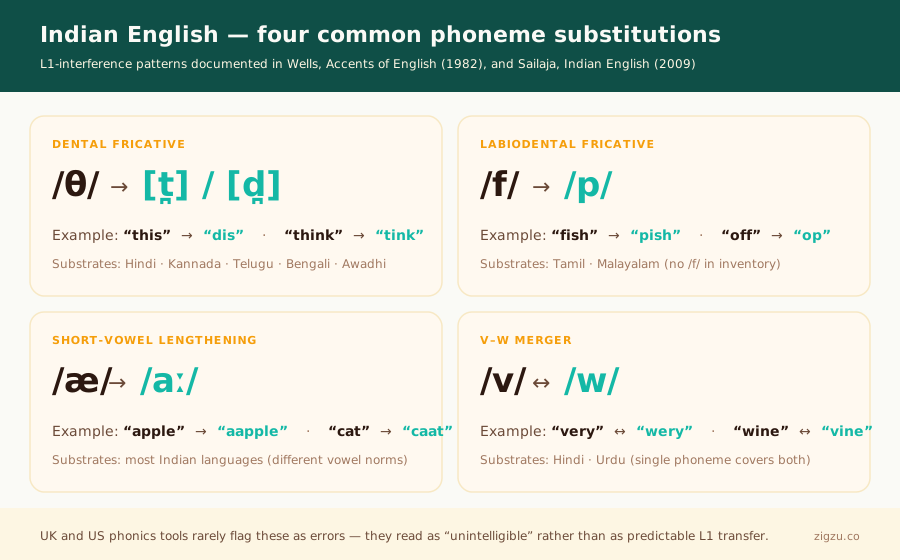
Tamil phonemes that do not exist in English — and vice versa
Tamil has retroflex consonants (sounds made with the tongue curled back) that English does not, and English has fricative sounds that Tamil does not. When a Chennai child encounters English, they substitute the nearest Tamil phoneme — consistently and predictably.
| English sound | Common Chennai substitution | Example |
|---|---|---|
| /f/ (fish, four, phone) | /p/ (Tamil has no /f/) | "pish" for "fish", "pour" for "four" |
| /z/ (zoo, zero, zebra) | /s/ or /j/ | "sebra" for "zebra", "sero" for "zero" |
| /θ/ (the, think, three) | /t/ or /d/ | "tank" for "thank", "dree" for "three" |
| Short /æ/ (cat, apple, bad) | /ɑː/ (Tamil long "aa") | "baard" for "bad", "aapple" for "apple" |
Tamil lacks the labiodental fricative /f/, so Tamil-medium learners consistently substitute /p/ — reading 'fish' as 'pish' — a foundational pattern documented in the descriptive linguistics of Indian English (Wells, Accents of English, 1982; Sailaja, Indian English, 2009). The substitution is essentially absent in Hindi-speaking children but predictable in Tamil-speaking beginning readers, and resolves quickly with consistent targeted oral practice.
Chennai schools teach the sounds. ZigZu catches the Tamil phoneme gaps your child's tutor might miss.
ZigZu is not a phonics class replacement. It is the daily at-home practice layer — listening to every word your child reads, catching Tamil phoneme substitutions in real time, teaching what was missed. In Indian English.
Hears every word your child reads. Teaches what they miss. In Indian English.
Available on Android & iOS · Free to start · No credit card required
Common questions from Chennai parents about phonics
My child attends a top Chennai CBSE/ICSE school — shouldn't the school phonics programme be enough?
These schools have excellent phonics programmes. But classroom instruction, however good, cannot provide the volume of daily oral reading practice that builds fluency. A child who reads aloud for 10 minutes every evening at home — with feedback on every word — will progress faster than one who only reads aloud in class. School phonics teaches the sounds. Daily home practice embeds them.
My Chennai child says "pish" for "fish" and "tank" for "thank" — is this a learning problem?
No — this is a Tamil phoneme substitution pattern, and it is completely predictable. Tamil has no /f/ or /θ/ sounds, so Tamil-speaking children default to the nearest Tamil equivalent. It is not a learning difficulty; it is a language transfer effect. The correct response is targeted daily practice specifically on these sounds — not alarm, not extra classes in general, but specific oral production practice for /f/ and /θ/ every day for 4–6 weeks.
My child reads English text correctly in class but switches to Tamil-influenced pronunciation at home — why?
This is a very common Chennai pattern. In school, children are modelling the teacher's pronunciation in real time. At home, without that model, they revert to their natural Tamil phoneme defaults. This shows the school phonics instruction is working cognitively — but the sounds have not yet been fully internalised. The fix is consistent daily oral reading at home with immediate feedback, so the correct sounds become habitual rather than effortful.
Frequently asked questions about phonics classes in Chennai
The best phonics programmes in Chennai pair systematic sound instruction with daily oral reading practice. For home reinforcement, choose a programme that teaches all 44 English phonemes in sequence and gives immediate feedback on every word your child reads aloud — not just worksheets. For Tamil-speaking children, the programme must also address Tamil phoneme substitution patterns.
Private phonics tutors in Chennai charge ₹2,500–₹6,000 per month depending on area — rates are highest in Adyar, Nungambakkam, and Anna Nagar. Reading centres charge ₹2,000–₹4,000 per month. Online AI coaching with unlimited daily sessions is free to start. Research shows children who practise reading aloud daily progress significantly faster than those attending weekly sessions.
Tamil phonology significantly shapes how Chennai children read English. Tamil has no /f/, /z/, or /th/ sounds — children consistently substitute 'p' for 'f' (saying 'pish' for 'fish'), 's' for 'z', and 't' or 'd' for 'th'. Tamil also has retroflex consonants not found in English, sometimes creating the reverse error. These patterns are predictable, addressable — but only by a phonics programme that recognises Tamil-English phoneme interference specifically.
Offline Chennai tutors offer human warmth and in-person correction — valuable qualities, especially for young learners. Online AI coaching delivers daily unlimited practice, which is the volume that actually drives fluency. The ideal combination is your child's school phonics instruction plus a daily 10-minute AI coaching session at home. ZigZu listens to every word your Chennai child reads aloud and corrects Tamil phoneme substitutions in real time.
Jolly Phonics is widely used in Chennai's CBSE and ICSE schools. Most established CBSE and ICSE schools in Chennai run a structured phonics programme. Ask your child's class teacher which phonics programme and sound group they are currently on — knowing this lets you target the right sounds during home practice sessions.
Ready to help your Chennai child build English reading fluency every day?
ZigZu catches Tamil phoneme substitutions — 'p' for 'f', 't' for 'th', 's' for 'z' — that UK phonics apps miss entirely. Daily practice free to start.
Start Reading with ZigZuAvailable on Android & iOS · Free to start · No credit card required