Phonics classes in Delhi for children aged 4–8 fall into three brackets: private home tutors charge ₹3,000–₹8,000 per month for two to four sessions a week, offline reading centres across South Delhi, Dwarka, Noida and Gurugram charge ₹2,500–₹5,000 per month for one or two weekly sessions, and online AI coaching is free to start with unlimited daily practice. Most Delhi CBSE and ICSE schools already teach phonics in LKG and UKG, usually through Jolly Phonics, so your child is likely covering the sounds in class already. The bigger gap sits at home: ASER 2023 found only 42.8% of Class 5 students can read a Class 2-level English text, and that gap closes through daily reading aloud with real feedback rather than more weekly classes. For a Hindi-speaking Delhi child, that feedback should also catch Indian English errors like "aapple" for "apple" and "dis" for "this".
- Most of Delhi's private CBSE schools introduce phonics in LKG or UKG, typically using the Jolly Phonics programme (CBSE Academic).
- ASER's annual surveys consistently find that fewer than half of Indian Class 5 students read a Class 2-level English text fluently — a gap that daily at-home reading practice, not more classes, consistently closes.
- Delhi children face a specific phonics challenge: Hindi vowels (अ, आ, इ, ई) map imperfectly onto English short vowels, causing errors like "eppal" for "apple" and "ambrella" for "umbrella" that persist without targeted correction.
Phonics classes in Delhi — what's available
Delhi parents searching for phonics classes for their children have three broad options: private home tutors, offline reading and phonics centres, and online programmes. Each has a different cost profile, frequency model, and learning outcome.
Private home tutors
Delhi's private tuition market for young children is large and competitive. English reading tutors — many of whom incorporate phonics methods — charge ₹3,000 to ₹8,000 per month for two to four sessions per week. Quality varies widely. A tutor who understands systematic phonics (teaching the 44 sounds in sequence) will produce different results than one who focuses on whole-word memorisation or general English speaking.
Offline reading centres
Centres offering structured reading programmes operate across South Delhi, Noida, Gurugram, and Dwarka. These typically run 45–60 minute group or individual sessions, one to two times per week. Monthly costs range from ₹2,500 to ₹5,000 depending on class size and frequency. The key limitation of any once-a-week programme is that reading fluency requires daily practice — one session per week produces measurably slower progress than daily short sessions.
What Delhi schools already provide
Most private CBSE and ICSE schools in Delhi introduce phonics in LKG or UKG, typically using the Jolly Phonics programme from Jolly Learning Ltd. Many of Delhi's established CBSE and ICSE schools incorporate phonics instruction in their early-years curriculum. This means your child is likely already receiving phonics teaching — the question is whether they are getting enough daily practice to embed it.
How much do phonics classes cost in Delhi?
Here is a direct cost comparison of the main options available to Delhi parents in 2026:
| Option | Monthly cost | Sessions/week | Daily practice? | Indian English? |
|---|---|---|---|---|
| Private home tutor (Delhi) | ₹3,000–₹8,000 | 2–4 sessions | No | Varies by tutor |
| Offline reading centre | ₹2,500–₹5,000 | 1–2 sessions | No | Rarely |
| UK/US phonics apps | ₹400–₹1,200 | Unlimited | Yes | No — misses Indian English errors |
| ZigZu AI Reading Coach | Free to start | Unlimited | Yes | Yes — built for Indian English |
Whichever option you pick, the most important comparison is not cost but frequency. A child who practises reading aloud for 10 minutes every day builds fluency faster than one who attends a single longer weekly session. The right question is not "which is cheapest?" but "which option puts the most daily reading practice in front of my child?"
What actually builds reading fluency for Delhi children
Research from the National Reading Panel (NRP, 2000) established that the five components of effective reading instruction are: phonemic awareness, phonics, fluency, vocabulary, and comprehension. Of these, fluency is the component most directly built by daily oral reading practice — and it is the component most commonly neglected in Delhi's current tuition model.
Daily practice beats infrequent sessions
Ten minutes of reading aloud every day produces more measurable fluency gains than a one-hour weekly session. Neural pathways for phonics decoding are strengthened through repetition, not intensity. If your Delhi child attends a phonics centre once a week but reads nothing in between, five out of seven days are lost.
Feedback on every attempt matters
A child who reads a word incorrectly without correction learns the wrong pronunciation. The quality of a phonics programme depends heavily on whether every error is caught and corrected. This is where offline tutors have historically outperformed apps — but AI coaching has closed this gap for Indian English specifically.
Indian English must be modelled, not replaced
The best phonics programmes for Delhi children do not try to replace Indian English with a British or American accent. They teach the 44 English phonemes as used in educated Indian English — which means addressing the specific phoneme substitutions Hindi speakers make, not treating the child's mother tongue as a problem to be erased.
Why Delhi's phonics classroom isn't a single Hindi classroom
Delhi is unusual among Indian metros for the breadth of Hindi varieties spoken at home. NCR draws families from across the Hindi belt — Standard Hindi, Bihari Hindi, eastern UP Hindi, Haryanvi, and Punjabi-influenced Hindi — each with slightly different vowel-length and voicing patterns. A child in a Delhi Class 1 classroom may sit beside three children whose home languages all map onto English differently.
This matters when phonics instruction comes from a single source — NCERT's Marigold I in CBSE, or Jolly Phonics in private schools. Both are sound, but neither anticipates that every child in the room is starting from a slightly different substrate. The shared error is the dental fricative substitution: Hindi has no /θ/ or /ð/, so children consistently substitute [t̪] or [d̪]. The surrounding short-vowel and aspiration patterns vary by home dialect — which is why a single-substrate phonics tool is a poor fit for Delhi specifically.
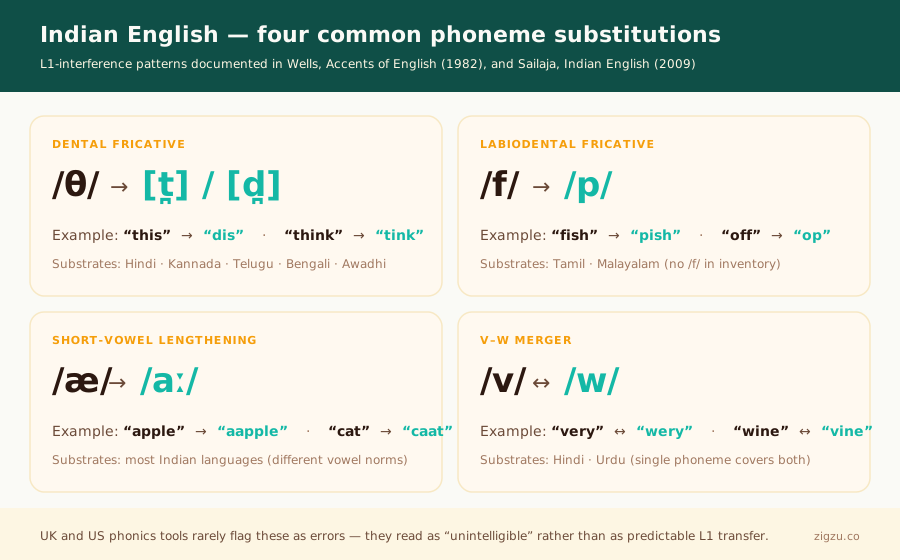
Hindi vowels vs English short vowels
Hindi has a clear distinction between short /a/ (as in "pat") and long /ā/ (as in "father"). English has five short vowels — /æ/, /ɛ/, /ɪ/, /ɒ/, /ʌ/ — that have no precise equivalents in Hindi. Delhi children frequently substitute the nearest Hindi vowel:
| English sound | Common Delhi substitution | Example |
|---|---|---|
| Short /æ/ (cat, apple, and) | /ɑː/ (long "aa") | "aapple" for "apple" |
| Short /ʌ/ (cup, umbrella, up) | /ɑ/ or /ʊ/ | "ambrella" for "umbrella" |
| /θ/ (the, this, that) | /d/ or /t/ | "dis" for "this" |
| /v/ vs /w/ distinction | Merged as /v/ | "very" and "wary" sound identical |
Hindi has no dental fricative in its phoneme inventory, so Hindi-medium learners consistently substitute [t̪] or [d̪] for English /θ/ — a foundational pattern documented in the descriptive linguistics of Indian English (Wells, Accents of English, 1982; Sailaja, Indian English, 2009). The substitution is predictable and correctable with targeted oral practice, but UK and US phonics programmes are not calibrated to flag it as an error in Indian English contexts.
UK and US phonics apps are calibrated to British or American child speech. They consistently miss or misclassify the specific error patterns Delhi children produce — meaning a Delhi child could complete an entire UK phonics app programme while still saying "dis" for "this" and receiving no correction.
Your child's Delhi school teaches the sounds. ZigZu listens while they practise aloud at home.
ZigZu is not a phonics class. It is the daily reading practice layer that works alongside your child's school programme — listening to every word, catching every error, teaching what was missed.
Hears every word your child reads. Teaches what they miss. In Indian English.
Available on Android & iOS · Free to start · No credit card required
Common questions from Delhi parents about phonics
My child's Delhi school sends home phonics worksheets but doesn't explain the method — what should I do?
Ask the class teacher which phonics programme the school uses (most Delhi CBSE schools use Jolly Phonics) and which sound group they are currently on. Then read our Jolly Phonics India guide — it explains every group and what your child should be able to do at each stage. Once you know where your child is, daily 10-minute read-aloud sessions at home will compound their progress significantly.
My child speaks Hindi at home — will this affect their phonics learning?
It will create specific challenges, yes — but these are predictable and addressable. Hindi-speaking Delhi children consistently struggle with the "th" sound, short English vowels, and the v/w distinction. Any good phonics programme will address these. The key is that the programme must be calibrated to Indian English, not a UK or US model that won't recognise Hindi-influenced pronunciation patterns as distinct from correct reading.
Is there a government phonics programme in Delhi schools?
NEP 2020 mandates foundational literacy instruction by Class 3. The NIPUN Bharat mission targets basic reading and numeracy by Grade 3. However, in private CBSE schools, phonics instruction is implemented at the school's discretion. Most leading private Delhi schools introduced systematic phonics programmes between 2015 and 2022 — but the quality and consistency of implementation varies significantly between schools and even between teachers within the same school.
My child is in Class 2 and still struggles to read — is phonics the right intervention?
For most Class 2 Delhi children who are struggling to read, systematic phonics intervention is the correct first response — provided they have no underlying language processing issues. Check whether they know the 44 phonics sounds: ask them to sound out three-letter nonsense words like "zop" or "bim." If they cannot, phonics knowledge is the gap. Daily decodable book reading with immediate oral feedback will typically show measurable improvement within 6–8 weeks.
Frequently asked questions about phonics classes in Delhi
The strongest phonics programmes in Delhi combine systematic sound instruction with daily reading practice. Most reputable options teach the 44 English phonemes in a structured sequence — the same approach taken by Delhi's established CBSE and ICSE schools. When evaluating any programme, ask whether children practise reading aloud with feedback, not just worksheet exercises. Daily oral practice is where fluency is actually built.
Private phonics tutors in Delhi typically charge ₹3,000–₹8,000 per month for one-hour weekly sessions. Reading and phonics centres charge ₹2,500–₹5,000 per month. Online AI coaching — which allows unlimited daily practice — is free to start. The cost difference matters less than frequency of practice: a child who reads aloud daily progresses faster than one who attends one hour of class per week.
Both have advantages. Offline classes in Delhi offer human interaction and real-time correction from a teacher. Online AI coaching offers unlimited daily practice at home, which drives fluency more than class time. The strongest outcomes come from combining both: your child's school teaches phonics sounds, and a daily at-home practice session reinforces them. ZigZu listens to your child read aloud and catches errors in real time.
Most Delhi CBSE schools begin phonics instruction in LKG or UKG, when children are 4–5 years old — and this is the right time to start. Children who begin phonics between ages 4 and 6 consistently show stronger reading outcomes by Class 2 than those who start later. If your child is already in Class 1 or 2 and hasn't had systematic phonics, starting now still makes a significant difference.
Jolly Phonics is widely used across Delhi's CBSE and ICSE schools. Most established CBSE and ICSE schools in Delhi run a structured phonics programme. Ask the class teacher which phonics programme they follow and which sound groups they have completed so far this year.
Ready to give your Delhi child daily reading practice at home?
ZigZu listens to every word your child reads aloud and catches the specific errors Delhi children make — including Hindi vowel substitutions and the 'th' sound.
Start Reading with ZigZuAvailable on Android & iOS · Free to start · No credit card required