Phonics classes in Noida for children aged 4–8 range from private tutors charging ₹2,500–₹7,000 per month to online programmes free to start. Most Noida CBSE and ICSE schools already teach phonics in LKG and UKG — what children need at home is daily reading practice with immediate feedback.
- Most private English-medium schools across Gautam Buddh Nagar district (Noida and Greater Noida) introduce phonics in LKG or UKG, typically using the Jolly Phonics programme (CBSE Academic).
- ASER 2023: only 42.8% of Class 5 students can read a Class 2-level English text — a gap that daily at-home reading practice, not more classes, consistently closes.
- Noida homes mix Hindi, a large Punjabi-origin community, and eastern-UP migrant families — each producing predictable English slips (short vowels, the 'th' sound, dropped word-initial 'h') that persist without targeted correction and that UK/US phonics apps routinely miss.
Phonics classes in Noida — what's available
Noida is a planned, sector-numbered city, and that shapes the phonics market in a way it doesn't elsewhere: tutors and reading centres cluster by sector rather than by a single high street, and a family in Sector 78 often picks a tutor two sectors over rather than crossing the city. Broadly, parents here weigh three options — a private home tutor, an offline reading or phonics centre, and an online programme — each with a different cost, frequency, and outcome profile.
Private home tutors
Home-tutor supply is thickest in the dense residential belts: the Sector 50, 51, 76, 78 and 100 high-rises, and the older Sector 15A–37 stretch near the DND. Reading tutors who fold in phonics typically ask ₹2,500 to ₹7,000 per month for two to four sessions a week. The quality spread is wide. A tutor who teaches all 44 sounds in a structured Jolly-Phonics-style sequence gets different results from one running whole-word flashcards or general spoken-English drills — so ask, plainly, which phonics method they use before you commit.
Offline reading centres
Dedicated reading and phonics centres concentrate in the commercial hubs — the Sector 18 market, the Sector 62 and 63 office corridor, and newer pockets in Sector 137 and 168 near the Noida-Greater Noida Expressway. Expect 45–60 minute sessions once or twice a week at roughly ₹2,000–₹4,500 per month. The once-a-week format has a built-in ceiling: fluency comes from daily reading, and a single weekly slot — however good the teacher — leaves five or six days with no practice at all.
What Noida schools already provide
Here is the part most Noida parents overlook. Across Gautam Buddh Nagar — the district that holds both Noida and Greater Noida — the established private CBSE and ICSE schools almost all start phonics in LKG or UKG, usually on the Jolly Phonics sequence. So your child is very likely already being taught the sounds in class. The missing piece is rarely more instruction; it is daily reading-aloud practice at home, with someone catching the errors.
How much do phonics classes cost in Noida?
A direct cost comparison of the main options available to Noida parents in 2026:
| Option | Monthly cost | Sessions/week | Daily practice? | Indian English? |
|---|---|---|---|---|
| Private home tutor (Noida) | ₹2,500–₹7,000 | 2–4 sessions | No | Varies by tutor |
| Offline reading centre | ₹2,000–₹4,500 | 1–2 sessions | No | Rarely |
| UK/US phonics apps | ₹400–₹1,200 | Unlimited | Yes | No — misses Indian English errors |
| ZigZu AI Reading Coach | Free to start | Unlimited | Yes | Yes — built for Indian English |
Whichever option you pick, the most important comparison is not cost but frequency. A child who practises reading aloud for 10 minutes every day builds fluency faster than one who attends a single longer weekly session. The right question is not "which is cheapest?" but "which option puts the most daily reading practice in front of my child?"
What actually builds reading fluency for Noida children
The National Reading Panel (NRP, 2000) identified five pillars of effective reading instruction: phonemic awareness, phonics, fluency, vocabulary, and comprehension. Of these, fluency is the one built almost entirely through daily oral reading — and it is the one a sector-clustered, once-a-week tuition model in Noida is least able to deliver. Three things matter more than which centre you pick.
A short daily session beats a long weekly one
Ten minutes of reading aloud every evening does more for fluency than a single hour-long class. Decoding pathways are built by repetition, not by intensity. For a Noida family already managing a school bus that leaves a high-rise at 7 a.m. and a parent commute over the DND or Aqua Line metro, a fixed weekly centre slot is fragile — miss it for a wedding or a Monsoon-week traffic jam and the whole week is gone. A 10-minute home routine survives all of that.
Errors must be caught the moment they happen
When a child reads a word wrong and nobody corrects it, the wrong version is what sticks. Whether a programme actually improves reading comes down to one thing: is every slip caught and fixed in the moment? A live tutor does this well; a worksheet or a video lesson cannot. AI coaching tuned to Indian English now does it too — listening word by word as the child reads.
Indian English is the target, not a British accent
A good programme for a Noida child is not trying to sand off the way the family speaks. It teaches the 44 English phonemes as they sound in educated Indian English and corrects the predictable Hindi- and Punjabi-influenced slips — never framing the child's home language as a fault to be fixed.
Noida's three-language home mix — and why it changes the phonics brief
Noida looks like a Hindi-speaking city on the surface, but its homes are more layered than that. Three threads run through a typical Class 1 classroom here. First, mainstream Khariboli Hindi — the default. Second, a large Punjabi-origin population: Noida absorbed decades of overflow from Delhi's Punjabi neighbourhoods, and many families in the older sectors and across Greater Noida West (Noida Extension) speak Punjabi or Hindi-Punjabi at home. Third, a steady stream of eastern-UP and Bihari professional families — drawn by the Sector 62 and 137 IT corridor — who bring Awadhi, Bhojpuri and Maithili registers with them. A single school in Sector 50 or 168 can hold all three.
That mix matters because the phonics slips are not identical across the three. The Hindi and eastern-UP children share the classic substrate pattern — no dental fricative, and short English vowels stretched toward Hindi vowel norms. The Punjabi-origin children add a couple of their own: a tendency to drop or soften word-initial /h/ ("ouse" for "house") and a different stress rhythm. A UK or US phonics app, built around a single imagined accent, treats none of these as the predictable, correctable patterns they are. For Noida specifically, the practical takeaway is blunt: the programme has to recognise more than one home language behind the English.
Layered on top is the city's rhythm. Noida runs on long school days and long parent commutes — over the DND Flyway and Chilla into south Delhi, or out along the Noida-Greater Noida Expressway and the Aqua Line metro. That leaves most families a single narrow window for reading at home, usually just before bed. A programme built around a fixed 45-minute weekly centre slot fits that calendar badly; a 10-minute daily routine fits it almost perfectly.
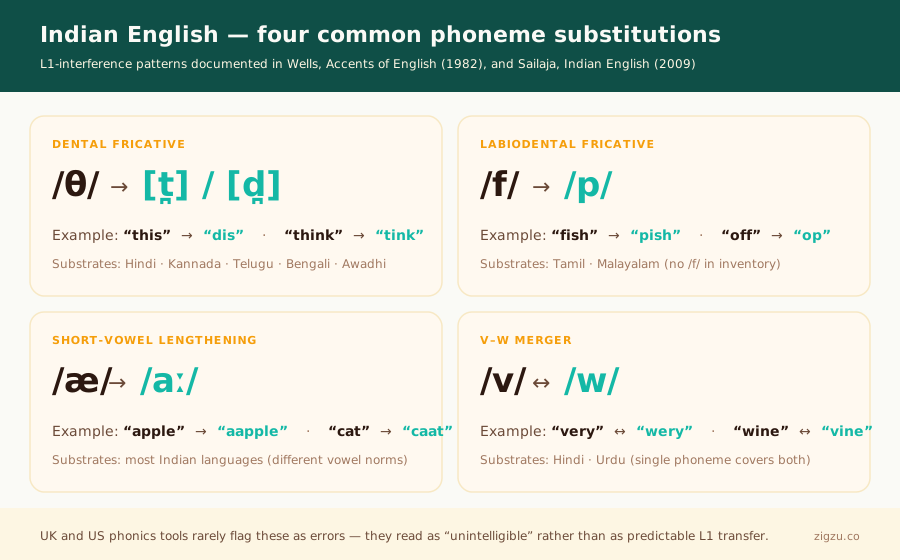
The slips a Noida classroom actually produces
English has five short vowels — /æ/ (apple), /ɛ/ (egg), /ɪ/ (it), /ɒ/ (on), /ʌ/ (up) — with no clean equivalents in Hindi or Punjabi, so children reach for the nearest sound from home. The first three rows below apply broadly across Noida's Hindi and eastern-UP families; the last row is the marker the city's large Punjabi-origin community adds on top. A teacher who knows the mix is looking out for all of them at once.
| English sound | Common Noida substitution | Example |
|---|---|---|
| Short /æ/ (cat, apple, and) | /ɑː/ (long "aa") | "aapple" for "apple" |
| Short /ʌ/ (cup, umbrella, up) | /ɑ/ or /ʊ/ | "ambrella" for "umbrella" |
| /θ/ (the, this, that, think) | /d/ or /t/ | "dis" for "this", "tank" for "thank" |
| Word-initial /h/ (Punjabi-origin homes) | Dropped or softened | "ouse" for "house", "and" for "hand" |
The vowel and dental-fricative patterns are the deepest-rooted. Hindi has no dental fricative in its phoneme inventory, so Hindi-medium learners consistently substitute [t̪] or [d̪] for English /θ/ — a foundational pattern documented in the descriptive linguistics of Indian English (Wells, Accents of English, 1982; Sailaja, Indian English, 2009). The Punjabi /h/-dropping is well attested in the same literature. A child finishing a UK phonics programme could clear every level while still saying "dis" for "this" or "ouse" for "house" — and never once be corrected, because the programme was never built to hear an Indian classroom in the first place.
Your child's Noida school teaches the sounds. ZigZu listens while they practise aloud at home.
ZigZu is not a phonics class. It is the daily reading practice layer that works alongside your child's school programme — listening to every word, catching every error, teaching what was missed.
Hears every word your child reads. Teaches what they miss. In Indian English.
Available on Android & iOS · Free to start · No credit card required
Common questions from Noida parents about phonics
My child's Noida school sends home Jolly Phonics worksheets but doesn't explain the method — what should I do?
Ask the class teacher which Jolly Phonics group they are currently on and what sounds your child should know. Then read our Jolly Phonics India guide — it explains every group and what children should be able to do at each stage. Once you know where your child stands, ten minutes of daily read-aloud at home will significantly accelerate their progress through the remaining groups.
We speak Hindi and a bit of Punjabi at home — will that affect my child's English phonics?
It will create specific, predictable slips — the five short English vowels and the 'th' sound for Hindi, plus a tendency to drop word-initial 'h' (saying "ouse" for "house") in many Punjabi-origin Noida homes. None of this reflects the child's ability; these are simply gaps between the home language and English. A good programme expects them. What matters is that it is built for Indian English and the real Noida home-language mix, not a UK model that hears these patterns as random mistakes rather than the predictable ones they are.
My child is in Class 2 in a Noida CBSE school and still struggles to read fluently — what should I try first?
For most Class 2 Noida children, phonics intervention is the correct first response to reading difficulty. Check quickly: ask your child to read three-letter nonsense words like "zop" or "bim". If they cannot decode them, phonics knowledge is the gap. If they can decode but read slowly, it is a fluency gap — which daily read-aloud practice addresses directly. In most cases, ten minutes of daily oral reading with immediate feedback produces visible improvement within four to six weeks.
Are there good phonics classes in Greater Noida or Noida Extension?
Dedicated offline phonics centres are thinner on the ground in Greater Noida and Greater Noida West (Noida Extension) than in the older core sectors, even as those areas have filled with young families. Most parents there lean on home tutors or online programmes. It is exactly where daily at-home coaching earns its keep: consistent practice every evening, no Aqua Line metro ride or expressway run to a centre, whichever society you live in.
Frequently asked questions about phonics classes in Noida
The strongest phonics options in Noida combine systematic sound instruction with daily reading practice. Most reputable programmes teach the 44 English phonemes in sequence — the same approach used by established CBSE and ICSE schools. When choosing a programme, ask whether children read aloud with feedback every day, not just complete worksheets. Daily oral practice is where reading fluency is built.
Private phonics tutors in Noida typically charge ₹2,500–₹7,000 per month for weekly sessions. Offline reading centres charge ₹2,000–₹4,500 per month. Online AI coaching, which provides unlimited daily practice, is free to start. Frequency matters more than cost: a child who practises reading aloud for 10 minutes every day progresses significantly faster than one who attends a one-hour weekly session — regardless of how experienced the teacher is.
Both have roles. Offline classes in Noida offer direct teacher interaction and structured lesson delivery. Online AI coaching delivers unlimited daily at-home practice — the component that drives reading fluency. The strongest outcomes come from combining both: your child's school teaches phonics sounds in class, and a daily at-home session reinforces them. ZigZu listens to your child read aloud, catches errors in real time, and teaches corrections in Indian English.
Most Noida CBSE schools begin phonics in LKG or UKG, when children are 4–5 years old — this is the correct starting age. Children who begin phonics between ages 4 and 6 develop stronger reading by Class 2 than those who start later. If your child is already in Class 1 or 2 without a strong phonics foundation, targeted daily practice will produce measurable improvement within 6–8 weeks.
Jolly Phonics is widely used across Noida's English-medium schools. Most established CBSE and ICSE schools in Noida run a structured phonics programme. If you are unsure whether your child's school uses Jolly Phonics, ask the class teacher which phonics programme they follow and which sound groups they have completed this term.
Ready to give your Noida child daily reading practice at home?
ZigZu listens to every word your child reads aloud and catches the specific errors Noida children make — Hindi vowel substitutions, the 'th' sound, and the dropped word-initial 'h' common in Punjabi-origin homes. Free to start, compared to ₹4,000+/month for a private tutor.
Start Reading with ZigZuAvailable on Android & iOS · Free to start · No credit card required