Phonics classes in Bangalore for children aged 4–8 range from private tutors at ₹3,000–₹7,000 per month to online AI coaching free to start. Most Bangalore CBSE and ICSE schools teach phonics in LKG and UKG — the gap is daily at-home practice where children read aloud and receive real-time feedback on every word.
- Most English-medium CBSE and ICSE schools in Bangalore introduce phonics in LKG or UKG using programmes such as Jolly Phonics, with NEP 2020's foundational literacy mandate accelerating adoption (NEP 2020).
- ASER's annual surveys consistently find that fewer than half of Indian Class 5 students read a Class 2-level English text fluently — a gap that daily oral reading practice, not more classroom instruction, consistently closes.
- Bangalore children who speak Kannada or Telugu at home face specific phoneme substitution challenges — particularly 'th' → 't/d', short /æ/ vowel errors, and v/w merging — that UK and US phonics apps systematically miss (ASER).
Phonics classes in Bangalore — what's available
Bangalore's strong English-medium school ecosystem and tech-forward parent community have made it one of India's most active markets for early literacy programmes. Parents searching for phonics support have several options, from traditional home tutors to specialist reading centres and AI-based coaching.
Private home tutors
In neighbourhoods like Koramangala, Whitefield, Indiranagar, and HSR Layout, English reading tutors charge ₹3,000 to ₹7,000 per month for two to four sessions per week. As with all private tutoring markets, quality varies significantly. The most effective tutors use a systematic phonics approach — teaching sounds in a specific sequence and tracking which of the 44 English phonemes each child has mastered. Many general "English tuition" tutors do not use this approach.
Offline reading centres
Bangalore has a growing number of reading and learning centres, particularly in Koramangala, JP Nagar, and Malleshwaram. These run structured group or individual sessions at ₹2,000–₹4,500 per month. The fundamental constraint remains frequency: a once-weekly 45-minute session cannot replicate the daily reading practice that produces fluency. Research consistently shows that daily short sessions outperform infrequent long ones for early readers.
What Bangalore schools already provide
Most English-medium CBSE and ICSE schools in Bangalore teach phonics from LKG. Many established CBSE and ICSE schools use structured phonics curricula — frequently Jolly Phonics. If your child attends one of these schools, they are already receiving phonics instruction. The variable is whether they are practising enough at home to embed it.
How much do phonics classes cost in Bangalore?
A direct cost comparison of options available to Bangalore parents in 2026:
| Option | Monthly cost | Sessions/week | Daily practice? | Indian English? |
|---|---|---|---|---|
| Private home tutor (Bangalore) | ₹3,000–₹7,000 | 2–4 sessions | No | Varies by tutor |
| Offline reading centre | ₹2,000–₹4,500 | 1–2 sessions | No | Rarely |
| UK/US phonics apps | ₹400–₹1,200 | Unlimited | Yes | No — misses South Indian English errors |
| ZigZu AI Reading Coach | Free to start | Unlimited | Yes | Yes — built for Indian English |
Whichever option you pick, the most important comparison is not cost but frequency. A child who practises reading aloud for 10 minutes every day builds fluency faster than one who attends a single longer weekly session. The right question is not "which is cheapest?" but "which option puts the most daily reading practice in front of my child?"
What builds reading fluency for Bangalore children
The National Reading Panel (NRP, 2000) identified five pillars of reading instruction. For Bangalore children specifically, fluency — built through daily oral reading — is the pillar most commonly under-served by existing tuition options.
Consistent daily practice beats intensity
Reading 10 minutes aloud every day produces more fluency gains than a one-hour session twice a week. For Bangalore children with packed school schedules and after-school activities, short daily sessions are also more realistic. The key is that practice must include feedback — silent reading builds vocabulary but not phonics decoding accuracy.
Correction must be immediate and specific
When a Bangalore child says "dat" for "that," they need to hear the correction at that moment — not at the end of the paragraph. Delayed correction allows the error to consolidate. The best phonics programmes, whether human or AI, correct at the word level in real time. This is the technical bar that distinguishes effective coaching from passive listening.
The programme must recognise Indian English
A Bangalore child reading "this" as "dis" is not making a random error — they are applying a consistent Kannada or Telugu phoneme rule. UK and US phonics apps are not calibrated to recognise this as a specific, correctable pattern. They either pass it as correct or flag it as unintelligible. Neither helps the child. ZigZu's model is trained on Indian children's English and catches this category of error specifically.
Bangalore's multilingual classroom — a reading challenge most cities don't have
Bangalore is one of India's most linguistically diverse metros. Kannada, Telugu, Tamil, Hindi, and Malayalam are all common home languages, and many children navigate two or three of them alongside English. This is materially different from Chennai (Tamil-dominant) or Lucknow (Hindi/Awadhi-dominant) — a Bangalore Class 1 classroom can contain children with four or five different L1-interference profiles in a single roll-call.
Three substrate patterns dominate in practice. Kannada and Telugu speakers consistently substitute [t̪] or [d̪] for English /θ/ — the same pattern as Hindi speakers, since none of these languages has a dental fricative. Tamil speakers add a distinct /f/ → /p/ substitution, since Tamil has no labiodental fricative. Malayalam speakers tend to over-apply retroflexion in English, which UK/US phonics tools register as unintelligible rather than as a coherent L1 transfer. A programme calibrated to a single phoneme inventory misses most of these for most children.
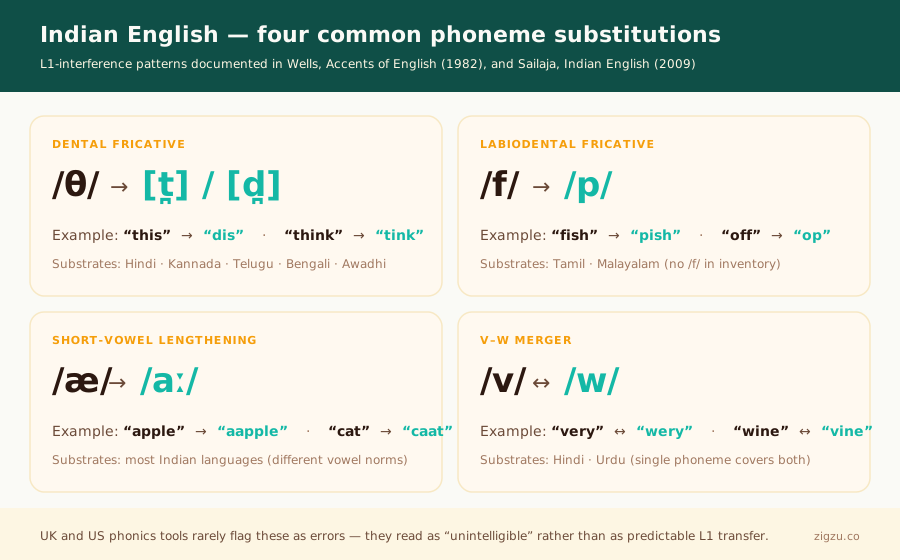
Sounds that Kannada and Telugu speakers consistently substitute
| English sound | Common Bangalore substitution | Example |
|---|---|---|
| /θ/ (th — voiced and unvoiced) | /t/ or /d/ | "dat" for "that", "tink" for "think" |
| Short /æ/ (cat, bat, apple) | /ɑː/ (longer "aa") | "baat" for "bat", "aapple" for "apple" |
| /v/ vs /w/ distinction | Merged as /v/ | "vine" and "wine" sound identical |
| /z/ (zoo, zebra, zero) | /s/ or /j/ | "sebra" for "zebra" |
Kannada and Telugu lack the dental fricative, so Kannada- and Telugu-speaking learners consistently substitute [t̪] or [d̪] for English /θ/ — a foundational pattern documented in the descriptive linguistics of Indian English (Wells, Accents of English, 1982; Sailaja, Indian English, 2009). This is a predictable L1-interference pattern, not a sign of poor learning. UK and US phonics programmes are not calibrated to address it specifically.
Your child's Bangalore school teaches phonics. ZigZu practises it with them every day.
ZigZu is not a substitute for classroom phonics instruction. It is the daily oral practice layer that turns classroom knowledge into reading fluency — listening to every word, catching the errors Kannada and Telugu speakers consistently make, teaching what was missed.
Hears every word your child reads. Teaches what they miss. In Indian English.
Available on Android & iOS · Free to start · No credit card required
Common questions from Bangalore parents about phonics
My child's Bangalore school uses Jolly Phonics but I don't know which group they're on — how do I find out?
Ask the class teacher directly: "Which Jolly Phonics group is the class currently on?" Jolly Phonics has 7 groups of 6 sounds each. Knowing the current group tells you exactly which sounds to practise at home. Our Jolly Phonics India guide has a full breakdown of all 7 groups with what children should be able to do at each stage — including which sounds are hardest for Indian children.
My child speaks Kannada at home — will this slow down their English phonics progress?
It will create predictable challenges, not insurmountable ones. Kannada speakers consistently struggle with the "th" sound, short English vowels, and the v/w distinction. These are addressable through targeted practice — but the programme must recognise Kannada-influenced English as a distinct pattern, not just flag it as wrong. A phonics programme calibrated to Indian English will correct these patterns systematically rather than penalising them as general errors.
Is there a difference between phonics teaching quality in Bangalore's schools across areas?
Yes — significantly. Established schools in Koramangala, Indiranagar, and Whitefield tend to have better-resourced phonics programmes with trained teachers and structured assessment. Schools in outer Bangalore or government CBSE schools vary widely. NEP 2020's NIPUN Bharat mission aims to level this by Class 3, but implementation is still inconsistent across Karnataka. Regardless of school quality, daily at-home practice is within every parent's control.
Frequently asked questions about phonics classes in Bangalore
The strongest phonics programmes in Bangalore combine systematic sound instruction with daily oral reading practice. Many established CBSE and ICSE schools already use phonics-based curricula. For home reinforcement, look for programmes that teach the 44 English phonemes in sequence and provide real-time feedback on every attempt — not just worksheets. Daily read-aloud practice, even 10 minutes, consistently produces faster fluency gains than weekly group sessions.
Private phonics tutors in Bangalore typically charge ₹3,000–₹7,000 per month, with rates higher in Whitefield, Koramangala, and Indiranagar. Reading centres charge ₹2,000–₹4,500 per month. Online AI coaching with unlimited daily sessions is free to start. Frequency matters more than cost: children who practise reading aloud every day progress measurably faster than those in one weekly session regardless of tutor quality.
Both serve different purposes. Offline Bangalore classes offer human connection and in-person correction. Online AI coaching gives daily unlimited practice — the volume that drives fluency. Bangalore's tech-forward parent community tends to adopt AI learning tools early. The best outcomes come from pairing school phonics instruction with daily at-home AI coaching: the school teaches sounds, the at-home session practises them aloud every day.
Kannada has a rich vowel system but lacks several English phonemes: the 'th' sound, the short /æ/ vowel (as in 'cat'), and the v/w distinction. Bangalore children who speak Kannada or Telugu at home often substitute 't' or 'd' for 'th', merge v and w, and pronounce short English vowels with a longer Kannada quality. These patterns require a phonics programme calibrated to South Indian English, not a UK or US model.
Jolly Phonics is used in many Bangalore CBSE and ICSE schools. Most established CBSE and ICSE schools in Bangalore run a structured phonics programme. Ask your child's class teacher which phonics programme and sound group they are currently on to understand where your child stands in the sequence.
Ready to give your Bangalore child daily reading practice at home?
ZigZu catches the specific errors Kannada and Telugu-speaking children make — including 'th' substitutions and short vowel errors that UK phonics apps miss.
Start Reading with ZigZuAvailable on Android & iOS · Free to start · No credit card required