Alphabet sounds are the individual phonics sounds each letter makes, which is not the same thing as the letter's name. The letter b is called 'bee', but the sound it makes is /b/, as in bat. A child reading the word bat says /b/, /a/, /t/ and blends them, not 'bee-ay-tee'. That is why every serious phonics programme teaches letter sounds first and lets the names arrive later.
English has 26 letters but 44 distinct sounds, so the letters and the sounds never line up neatly. For Indian children, the hardest are the five short vowels, as in apple, egg, it, on, and up, and the 'th' sound, which most Indian languages do not have. Two other predictable swaps show up often: v and w used interchangeably by Hindi speakers, and /f/ read as /p/ by Tamil speakers. None of these are learning difficulties. They are sound gaps that respond to direct, daily practice.
- English has 26 letters but 44 distinct phonemes — children must learn letter sounds first, not letter names, to decode words. Teaching 'b says /b/' before 'b is called bee' is the method used by Jolly Phonics, CBSE phonics units, and all major Indian school programmes.
- ASER's annual surveys regularly find that fewer than half of Indian Class 5 children in government schools read Class 2 level text in their regional language fluently — a gap that begins when children learn letter names but not letter sounds in the early years.
- ZigZu's Indian English speech model is trained to identify the specific alphabet sound errors Indian children make — including /θ/→/d/ for 'th', short vowel errors, and the /v/~/w/ merge — which UK and US reading apps regularly miss or reject as unintelligible.
It is hard to tell by ear. ZigZu listens while your child reads a storybook aloud, spots the words they say wrong, and teaches those sounds right there, in Indian English.
Try ZigZu freeAndroid and iPhone · 100+ storybooks · No ads
What are alphabet sounds and why do they matter?
When an Indian parent says their child "knows the alphabet", they usually mean the child can recite A-B-C in order and recognise the letter shapes. This is letter knowledge — and while it is useful, it is not the same as phonics knowledge. The distinction matters enormously for learning to read.
Letter names vs letter sounds
The letter 'B' has a name ("bee") and a sound (/b/ as in "bat"). When you read the word "bat", you do not say "bee-ay-tee" — you say /b/-/a/-/t/ and blend them together. This means a child who knows letter names but not letter sounds cannot decode words. They need to know that 'b' makes the sound /b/, 'a' makes the sound /a/, and 't' makes the sound /t/ before they can read their first word.
This is why every serious phonics programme — including Jolly Phonics, and ICSE phonics workbooks — begins with letter sounds, not letter names. The name comes later, almost automatically, once the sound is established.
The 26 letters and 44 phonemes problem
English has 26 letters but 44 distinct phonemes (sounds). This is the core complexity of English phonics. The letter 'c' makes one sound in "cat" (/k/) and a different sound in "city" (/s/). The letters 'th' together make a sound — /θ/ — that has no equivalent in most Indian languages. The letters 'sh', 'ch', 'ph', and 'wh' are digraphs: two letters making one sound. Understanding alphabet sounds is the foundation, but full phonics fluency requires understanding how letters combine into these 44 phonemes. This page focuses on the 26 individual alphabet sounds — the essential starting point.
Why alphabet sounds matter for Indian English specifically
Indian children learning English face a specific challenge that children in the UK or US do not: several English phonemes simply do not exist in Indian languages. A child from a Hindi-speaking family will not have grown up hearing the short 'a' sound as in "apple" — Hindi has a longer 'aa' (आ) but not the clipped English /æ/. A Tamil-speaking child will not have heard the /f/ sound — Tamil lacks it entirely. These are not learning difficulties; they are phoneme gaps that require explicit, targeted teaching. Understanding which of the 26 alphabet sounds are difficult for Indian children is the first step to closing those gaps.
What are the 26 English alphabet sounds? A to Z reference table
Your complete A-to-Z phonics sounds reference for Indian English. Each row shows the letter, its primary phonics sound, a keyword example, and notes on where Indian children usually struggle. Rows marked in amber are the sounds that Indian children most commonly mis-articulate, based on Indian English phonology patterns.
Tap any sound in the table to hear it. Every one of the 26 plays a real recording, so you can check your own pronunciation before you teach it. That matters more than it first appears: a parent who says the letter name ("bee") when the child needs the letter sound (/b/) is teaching the wrong thing, and most of us were taught the names first.
| Letter | Primary sound | Keyword | Indian English note |
|---|---|---|---|
| A a | (short a) | apple, ant, map | Most Indian children say the longer /a:/ (as in "father") instead of the clipped /æ/. "Apple" sounds like "aapple". Needs explicit correction. |
| B b | bat, ball, big | No difficulty for Indian children — /b/ exists in all major Indian languages. | |
| C c | (before a, o, u) | cat, cup, cold | Generally fine. Note that 'c' before e/i makes /s/ — this variant is a later phonics lesson. |
| D d | dog, dig, dad | No difficulty. Note: Indian children learning 'th' often substitute /d/ (see letter T below). | |
| E e | (short e) | egg, end, bed | Hindi /e/ is slightly different from English /ɛ/. South Indian children often pronounce "egg" as "aig". Short 'e' requires direct teaching. |
| F f | fish, fan, off | Hindi and most North Indian languages have /f/. Tamil, Malayalam, and some Kannada speakers substitute /p/ — "fish" becomes "pish". Flag for South Indian children. | |
| G g | goat, get, big | No difficulty. Note: 'g' before e/i makes /dʒ/ — a later lesson. | |
| H h | hat, hop, hot | Generally fine. Some children drop the /h/ in connected speech, saying "is" for "his". | |
| I i | (short i) | ink, it, big | Indian children often replace with the longer /iː/ — "it" sounds like "eat". The short /ɪ/ is one of the most regularly mispronounced sounds. |
| J j | jam, jump, jet | No difficulty — /dʒ/ exists in Hindi (ज) and most Indian languages. | |
| K k | kit, king, kick | No difficulty. Same sound as 'c' in "cat". | |
| L l | lip, leg, bell | Generally fine. Tamil has a distinct retroflex /l/ — some children apply this to English words. | |
| M m | map, men, mum | No difficulty for Indian children. | |
| N n | net, nap, ten | No difficulty. One of the easiest consonant sounds to acquire. | |
| O o | (short o) | ox, on, top | Indian children often say the longer /oː/ — "on" sounds like "oan". The British short /ɒ/ is the target sound in most phonics programmes used in Indian schools. |
| P p | pan, pot, top | No difficulty. Note: Tamil-speaking children substituting /p/ for /f/ will produce correct /p/ words but incorrect /f/ words. | |
| Q q | (as qu) | queen, quit, quack | Always taught as "qu" together. No specific Indian difficulty. |
| R r | rat, red, car | Indian /r/ is usually a tapped /ɾ/ rather than the English approximant /r/. Noticeable but not a reading barrier — comprehension is not affected. | |
| S s | sun, sit, bus | No difficulty. One of the first sounds taught in Jolly Phonics Group 1. | |
| T t | tap, ten, sit | No difficulty with /t/ itself. But when children encounter "th" (as in "the", "this", "think"), most Indian children substitute /t/ or /d/ — a separate, very common error. | |
| U u | (short u) | up, cup, bug | Hindi /u/ is closer to /ʊ/ — "cup" often sounds like "coop" in Indian English. The short /ʌ/ is one of the five critical short vowel sounds to teach clearly. |
| V v | van, vet, five | Hindi uses both /v/ and /w/ but does not regularly distinguish them. Many Indian children say "wery" for "very" or "van" with a /w/ onset. The v/w distinction requires explicit teaching. | |
| W w | wet, win, web | Paired with the v/w confusion above — children who merge v and w will use both inconsistently. Kannada and Telugu speakers are particularly prone to this merge. | |
| X x | fox, box, mix | Usually taught as "x says /ks/" at the end of words. No specific Indian difficulty. | |
| Y y | yes, yam, yet | No difficulty — /j/ as in "yes" exists in Hindi (य) and most Indian languages. | |
| Z z | zip, zoo, buzz | Tamil does not have /z/ — Tamil-speaking children often substitute /s/ — "zip" becomes "sip". For other Indian language speakers, no difficulty. |
Rows highlighted in amber are the sounds most commonly mispronounced by Indian children based on Indian English phonology patterns: A (short), E (short), I (short), O (short), U (short), V, and W.
The same chart on one A4 page, with the seven amber sounds marked, ready to stick on a wall or slip into a school bag. No sign-up, no email.
Where Indian children get stuck with alphabet sounds
Indian children learning English are not learning to read in their first language. They are learning to decode a language that has sounds their mother tongue does not have. This creates predictable, identifiable error patterns — not random mistakes. Understanding these patterns helps parents know exactly what to practise.
The five short vowel problem
The five short English vowels — /æ/ (apple), /ɛ/ (egg), /ɪ/ (it), /ɒ/ (on), /ʌ/ (up) — are the most regularly mispronounced sounds in Indian children's English reading. Hindi and most North Indian languages have longer, more open vowels. South Indian languages like Tamil and Kannada have a different vowel system entirely. The result is that Indian children systematically substitute a longer or different vowel, and often do not hear that they are doing so — because they are comparing their pronunciation to their internal reference point from their mother tongue, not to the English target.
The 'th' sound — the most common Indian English error
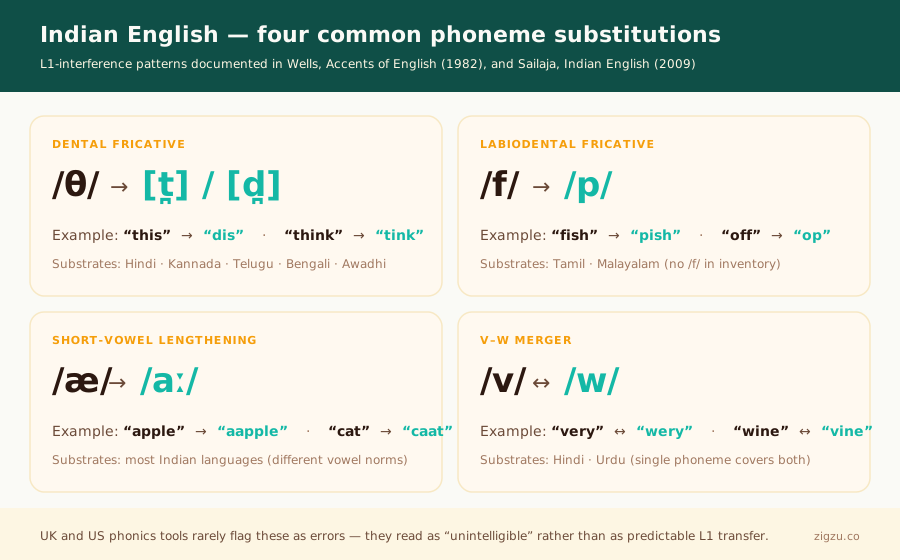
The /θ/ sound (as in "the", "this", "think", "three") is a dental fricative — the tongue touches the back of the upper teeth while air flows over it. Most Indian languages do not have this sound. Hindi has dental consonants (त, द) but they are stops, not fricatives. The result: nearly every Indian child substitutes /d/ for the voiced 'th' ("dis" for "this", "dat" for "that") and /t/ for the unvoiced 'th' ("tank" for "thank", "tink" for "think"). This substitution is so systematic that it is in effect universal among early Indian English readers. It requires direct, repeated correction — and a reading coach that can hear the difference.
The v/w merge in North and South India
Hindi treats /v/ and /w/ as variants of the same phoneme — the letter व is used for both "van" and "water" in transliteration. This means Hindi-speaking children do not have an internal distinction between the two sounds. Kannada and Telugu similarly have incomplete v/w distinction. Indian children reading English aloud will use /v/ and /w/ interchangeably — reading "very" as "wery" or "win" as "vin". This is not a single letter error; it is a phonemic distinction that does not exist in the child's first language and must be clearly taught.
The 'f'→'p' substitution in Tamil speakers
Tamil does not have the /f/ phoneme. Tamil-speaking children reading English will substitute /p/ — reading "fish" as "pish", "fat" as "pat", "off" as "op" — a foundational pattern documented in the descriptive linguistics of Indian English (Wells, Accents of English, 1982; Sailaja, Indian English, 2009). This is a very specific, predictable substitution that affects all words containing the letter 'f'. It is easy to correct once identified, but UK and US reading apps frequently either pass it (because they cannot recognise Indian accents) or flag it as unintelligible. ZigZu's speech model is built to recognise this substitution as a specific Indian English pattern rather than flagging it as unintelligible.
How to teach alphabet sounds at home: a 5-step plan
You do not need worksheets or expensive materials to teach alphabet sounds at home. A consistent 5-minute daily practice that focuses on sounds — not names — is enough to build a strong phonics foundation.
Start with the five short vowels every single day
Write a, e, i, o, u on a piece of paper. Point to each one and ask your child to say the sound — not the name. "A says /æ/ as in apple." "E says /ɛ/ as in egg." Do this at the start of every phonics session. Short vowels are the hardest sounds and require the most repetition. They should be the first thing your child hears and says every day, not something you cover once and move on from.
Use the "sound, keyword, mouth" method
For each letter, use three cues: say the sound, say a keyword, and show the mouth position. "B says /b/. Bat. Watch my lips — they start together." This multi-sensory approach is the core of programmes like Jolly Phonics (which adds a hand action to each sound). Multi-sensory encoding helps children retain phoneme-letter links much faster than visual drill alone.
Practise the six hard sounds separately
Once your child can produce all 26 basic sounds, focus daily attention on the six sounds most Indian children get wrong: short /æ/ (apple), short /ɪ/ (it), short /ʌ/ (up), /θ/ (the), /v/ (van), and /w/ (wet). For each, exaggerate your mouth position, ask your child to mirror you, and use minimal pairs — words that differ by only that sound: "pat/pet", "van/ban", "wet/vet".
Blend sounds into words as soon as your child knows 5–6 sounds
Blending is where phonics becomes reading. As soon as your child knows s, a, t, i, p, n — the first Jolly Phonics group — start blending. "What word do these sounds make: /s/ /a/ /t/?" Children who spend too long on isolated letter sounds without moving to blending often stall. The goal of learning letter sounds is to read words; start that connection early.
Let your child read aloud every day with feedback
Phonics knowledge becomes reading fluency through daily oral practice — reading storybooks aloud with immediate correction of every mispronounced word. A child who reads aloud for 10 minutes every evening will consolidate their alphabet sounds much faster than one who only does written phonics exercises. The reading must be aloud; silent reading does not build the phoneme-level accuracy that oral reading with feedback develops.
Your child reads aloud. ZigZu listens to every alphabet sound and catches every error — in Indian English.
Most reading apps accept any pronunciation as correct, or reject Indian accents entirely. ZigZu's speech model is trained on Indian children's English — it hears the difference between /æ/ and /a:/, catches /d/ for /θ/, and flags the v/w merge in real time.
Hears every word your child reads. Teaches what they miss. In Indian English.
Available on Android & iOS · Free to start · No credit card required
Common questions from Indian parents about alphabet sounds
My child's school uses Jolly Phonics — are those the same alphabet sounds?
Yes, with one addition. Jolly Phonics teaches the same 26 letter sounds described here, but organises them into 7 groups by frequency of use — starting with s, a, t, i, p, n because these letters can form dozens of simple words right away. Jolly Phonics also adds hand actions and songs to help children remember each sound. The phonics itself is identical; the teaching method is structured for faster blending.
My child knows all 26 letter sounds but still can't read — what am I missing?
Knowing isolated sounds is not the same as being able to blend them. Reading requires your child to hold multiple sounds in working memory simultaneously and merge them into a word. This blending skill is separate from sound knowledge and must be practised clearly. Try daily "say it slowly, say it fast" drills: you segment a word into sounds (/c/ /a/ /t/) and ask your child to blend them into the word. Start with three-sound words and build from there.
Should I teach capital and lowercase letters at the same time as the sounds?
Most phonics programmes, including Jolly Phonics, introduce lowercase letter forms first because these appear most frequently in reading text. Capital letters are introduced alongside their lowercase pairs, but the sound is always the same — 'A' and 'a' both make /æ/. Do not delay sound teaching until a child knows both forms. Start with lowercase, introduce sounds, then add capitals in the second phase of learning.
Frequently asked questions about alphabet sounds for kids
Teaching children letter names ('ay', 'bee', 'cee') is different from teaching letter sounds ('a' as in apple, 'b' as in bat, 'c' as in cat). Most phonics programmes — including Jolly Phonics and the phonics workbooks CBSE schools add — teach letter sounds first, because these are what children need to decode words. Learning letter names comes naturally afterwards, but the sound is what makes reading possible.
Indian children most commonly struggle with four categories of alphabet sounds. First, the short English vowels — 'a' as in 'apple', 'e' as in 'egg', 'i' as in 'it' — which do not exist in most Indian languages and get pronounced with the nearest mother-tongue equivalent. Second, 'th', which most Indian children say as 'd' or 't'. Third, 'v' and 'w', which many children merge. Fourth, 'f', which Tamil-speaking children often say as 'p'.
The most effective home method is a daily 5-minute drill: show a letter, ask your child to say its sound (not its name), then say a word starting with that sound. Start with the five short vowels — a, e, i, o, u — and the most common consonants: s, t, p, n, m. Once your child knows 10–12 sounds, start blending them into simple words: 'sat', 'map', 'tip'.
Most children in English-medium CBSE and ICSE schools begin systematic phonics at age 4–5 in LKG/UKG. By the end of UKG (age 5–6), many children who have had consistent phonics teaching know most letter sounds and are starting to blend simple consonant-vowel-consonant words like 'cat', 'sit', and 'hop'. If your Class 1 child still confuses five or more letter sounds, short daily practice on those sounds usually helps, and progress shows week by week.
Learning phonics in a mother tongue first is supported by NEP 2020 — children with a strong phonological foundation in their first language transfer those skills to English more efficiently. The challenge is that most Indian languages lack the short English vowels and the 'th' dental fricative. These specific gaps need explicit English phonics teaching, regardless of how strong a child's Hindi or Tamil reading foundation is.
Yes. You can teach all 26 alphabet sounds without perfect pronunciation, because the first job is showing your child that letters make sounds, not just names. For the six sounds Indian adults also mix up (the short vowels, 'th', 'v', 'w' and 'f'), use a recorded model: a free phonics video, the school workbook audio, or an AI Reading Coach like ZigZu that hears your child read aloud and corrects the sound in Indian English.
Ready to practise alphabet sounds in Indian English — every day, at home?
ZigZu listens while your child reads aloud, catches every alphabet sound error an Indian child makes, and teaches the correction in real time. Free to start.
Start Reading with ZigZuAvailable on Android & iOS · Free to start · No credit card required