Phonics help for Lucknow children aged 4–8 runs from private tutors at ₹2,000–₹6,000 a month down to online coaching that is free to start. Since Lucknow's English-medium schools already teach the sounds in LKG and UKG, usually through Jolly Phonics, the missing piece is daily reading aloud at home with someone — or something — that catches every slip. For a child raised on Hindi, Awadhi or Urdu, that feedback also needs to hear the local stumbles: "dis" for "this", a long "aa" in "apple", and "vet" and "wet" collapsing into one sound.
- Lucknow is Uttar Pradesh's state capital and home to some of India's oldest English-medium institutions — the majority of private CBSE and ICSE schools introduce phonics in LKG or UKG, with most using the Jolly Phonics programme (CBSE Academic).
- ASER 2023: only 42.8% of Class 5 students can read a Class 2-level English text — a gap that daily at-home reading practice, not more classes, consistently closes.
- Lucknow children from Hindi and Awadhi-speaking homes face specific phoneme gaps — short English vowels, the 'th' sound, and the v/w distinction — that persist without targeted correction and that UK/US phonics programmes routinely miss.
Phonics classes in Lucknow — what's available
Lucknow carries one of the oldest English-education legacies in north India, with convent and missionary schools that predate Independence sitting alongside a fast-growing wave of new CBSE campuses in the eastern suburbs. For a parent here, phonics support usually narrows to three routes: a private tutor who comes home, a neighbourhood reading centre, or an app your child uses on a phone.
Private home tutors
Home tuition for early reading is easy to arrange across Gomti Nagar, Indira Nagar, Aliganj, Hazratganj, and the newer belts around Vipul Khand and Vibhuti Khand. Rates in Lucknow tend to sit a notch below Delhi-NCR — most reading tutors who teach phonics ask ₹2,000 to ₹6,000 a month for two to four sittings a week. The catch is that "English tuition" in Lucknow often means homework help or spoken-English drilling, not structured phonics. A tutor who teaches the 44 sounds in a planned sequence and listens to your child decode aloud is a very different thing from one who has the child memorise word lists.
Offline reading centres
A handful of branded reading and phonics centres run in the Gomti Nagar and Hazratganj commercial stretches, with smaller home-run setups dotted through Aliganj and Mahanagar. Most book children for one or two 45–60 minute slots a week at ₹1,500–₹4,000 a month. The arithmetic problem is the same everywhere: a single weekly slot leaves your child with six days of no reading aloud, and fluency is not built on the seventh day alone.
What Lucknow schools already provide
Lucknow's English-medium schools — from the long-established missionary institutions to the newer Gomti Nagar CBSE campuses — almost all introduce phonics in LKG or UKG, and most lean on the Jolly Phonics sequence. So the sounds are very likely already being taught in your child's classroom. The piece that classroom time cannot cover is the daily ten minutes of reading aloud at home where those sounds actually stick.
How much do phonics classes cost in Lucknow?
Here is how the main options Lucknow parents weigh up actually stack against each other in 2026:
| Option | Monthly cost | Sessions/week | Daily practice? | Indian English? |
|---|---|---|---|---|
| Private home tutor (Lucknow) | ₹2,000–₹6,000 | 2–4 sessions | No | Varies by tutor |
| Offline reading centre | ₹1,500–₹4,000 | 1–2 sessions | No | Rarely |
| UK/US phonics apps | ₹400–₹1,200 | Unlimited | Yes | No — misses Indian English errors |
| ZigZu AI Reading Coach | Free to start | Unlimited | Yes | Yes — built for Indian English |
Notice that the cheapest options on this table are not the weakest ones. What separates them is not the monthly fee but how many days a week your child actually reads aloud and gets corrected. A ₹6,000 tutor seen twice a week still leaves five practice-free days; an app costing nothing to start can put ten minutes of guided reading into every single evening. For a Lucknow parent, the sharper question is not "what costs least?" but "what gets my child reading out loud the most often?"
What actually builds reading fluency for Lucknow children
The National Reading Panel (NRP, 2000) named five pillars of reading instruction: phonemic awareness, phonics, fluency, vocabulary, and comprehension. Of those, fluency is the one that grows almost entirely through reading aloud, day after day — and it is exactly the pillar Lucknow's once-a-week tuition culture tends to skip. Schools teach the sounds; very little in the city's tuition habit builds the daily reading reps that turn sounds into fluent reading.
A little every day beats a lot once a week
Ten minutes of reading aloud every evening will move a child further than a single hour-long session on a Saturday. Decoding gets quicker through repetition, not through one intense burst. A Lucknow child who visits a reading centre once a week and opens no book in between has, in effect, practised on one day out of seven.
Wrong words have to be caught the moment they happen
When a child reads a word wrong and nobody stops to fix it, the wrong version is what gets rehearsed. A phonics programme is only as good as its ability to notice every slip and correct it on the spot. Patient one-on-one tutors have always done this well; the reason apps lagged was that most never listened — until AI coaching tuned to Indian English caught up.
Indian English is the target, not a foreign accent
A good programme for a Lucknow child does not try to sand down their voice into a British or American one. It teaches the 44 English sounds the way educated Indian English uses them, and it knows the particular swaps a Hindi-, Awadhi- or Urdu-speaking child tends to make — treating the home language as the starting point, never as something to be fixed.
Lucknow's Urdu cultural overlay — and what it means for English phonics
Lucknow's home-language mix is unlike any other north Indian city. The everyday spoken tongue is a blend of Hindi and Awadhi — the regional language of the Avadh plains — while Urdu, with its own lexical register and Lakhnavi prestige, runs deep through the older quarters of Chowk, Aminabad, Nakhas, and parts of Hazratganj. A great many Lucknow children grow up hearing all three around them, even if "Hindi" is what they would name as their mother tongue. That layered background quietly shapes how a child first reads English aloud.
For phonics, the standout feature is the /v/–/w/ merger. It is unusually entrenched among Hindi and Urdu speakers — "vet" and "wet" land on the same sound — and it is precisely the kind of error a UK or US phonics app treats as correct because it never expected it. Awadhi also carries its own short-vowel habits that differ a touch from the textbook Khariboli Hindi taught in schoolbooks, so a Lucknow child's substitutions are not always the "standard Hindi" ones a generic programme assumes. The dental 'th' gap, on the other hand, is shared right across the Hindi belt: neither Hindi nor Awadhi has the English /θ/ or /ð/ at all.
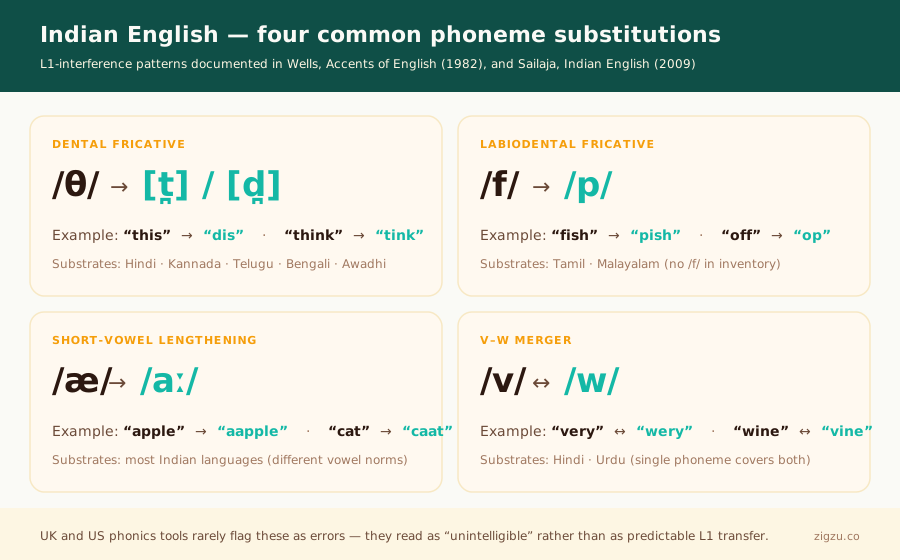
Where Awadhi and Hindi vowels meet English ones
The trouble with English short vowels is that several of them simply do not exist in Awadhi or Hindi, so a young reader reaches for the closest sound they already own. The result is a small set of predictable swaps you will hear in almost every Lucknow classroom — and once you can name them, they become easy to correct:
| English sound | Common Lucknow substitution | Example |
|---|---|---|
| Short /æ/ (cat, apple, and) | /ɑː/ (long "aa") | "aapple" for "apple" |
| Short /ʌ/ (cup, umbrella, up) | /ɑ/ or /ʊ/ | "ambrella" for "umbrella" |
| /θ/ (the, this, that, think) | /d/ or /t/ | "dis" for "this", "tank" for "thank" |
| /v/ vs /w/ distinction | Merged as /v/ | "very" and "wary" sound identical |
Because neither Hindi nor Awadhi carries a dental fricative, a Lucknow child reaches for [t̪] or [d̪] whenever English asks for /θ/ — turning "this" into "dis" and "thank" into "tank". Linguists have catalogued this as a defining feature of Indian English for decades (Wells, Accents of English, 1982; Sailaja, Indian English, 2009). The quiet danger is that a child can finish every level of an imported UK phonics app, score full marks, and still say "dis" on every page — because the app was never built to hear that the sound was wrong for an Indian reader.
Your child's Lucknow school teaches the sounds. ZigZu listens while they practise aloud at home.
ZigZu is not a phonics class. It is the daily reading practice layer that works alongside your child's school programme — listening to every word, catching every error, teaching what was missed.
Hears every word your child reads. Teaches what they miss. In Indian English.
Available on Android & iOS · Free to start · No credit card required
Common questions from Lucknow parents about phonics
My child's Lucknow school sends home Jolly Phonics worksheets but doesn't explain the method — what should I do?
Catch the class teacher and ask two things: which Jolly Phonics group the class is on right now, and which sounds your child is expected to know by this point. Then walk through our Jolly Phonics India guide, which lays out every group and what a child should be able to do at each stage. Once you can place your child on that map, ten minutes of reading aloud each evening will move them through the worksheets far faster than the worksheets alone ever could.
My child speaks Hindi or Awadhi at home — will that affect their English phonics?
It will, in very predictable ways. Expect the short English vowels, the 'th' sound, and the v/w pair to be the sticking points — and in Lucknow the v/w merger is especially stubborn because Hindi and Urdu both lean on it. None of this reflects on how bright your child is; it is simply where Awadhi and Hindi run out of sounds that English needs. A good programme will work through these, but only if it is built around Indian English. A UK app will quietly let "vet" and "wet" pass as the same word and never flag it.
My child is in Class 2 in a Lucknow CBSE school and still struggles to read fluently — what should I try first?
Start with phonics — for most struggling Class 2 readers it is the right first move. Run a quick home test: ask your child to sound out made-up words like "zop" or "bim". If they cannot, the gap is in phonics knowledge itself. If they decode them correctly but slowly, the gap is fluency, which only daily reading aloud will close. Either way, ten minutes a day with the errors corrected on the spot usually shows a visible difference inside four to six weeks.
Does ZigZu work for children at top Lucknow CBSE and ICSE schools?
Yes. Whether your child is at one of Lucknow's old convent schools or a newer Gomti Nagar CBSE campus, ZigZu sits alongside whatever phonics programme the school runs, Jolly Phonics included. It is not a substitute for the classroom — it is the evening reading practice the classroom has no time for. Ten minutes a night turns one or two weekly school sessions into daily reading aloud, with every slip caught and corrected in Indian English.
Frequently asked questions about phonics classes in Lucknow
The best phonics setup in Lucknow pairs structured sound teaching with reading aloud every day. Centres around Hazratganj and Gomti Nagar take children through the 44 English sounds in sequence, the same way the city's CBSE and ICSE schools do. The question to ask any tutor or centre is simple: does my child read aloud and get corrected daily, or just fill in worksheets? Daily reading aloud is where fluency is actually built, and for a Lucknow child that feedback should also catch Hindi, Awadhi and Urdu habits like saying 'dis' for 'this'.
In Lucknow, private phonics tutors usually charge ₹2,000–₹6,000 a month for a couple of weekly sittings, while neighbourhood reading centres run ₹1,500–₹4,000 a month. Online AI coaching with unlimited daily practice is free to start. Rates here tend to sit below Delhi-NCR, but the number that matters is not the fee. A child who reads aloud for ten minutes every day will pull ahead of one who attends a single hour-long weekly class, however good the teacher is, because fluency is built on frequency, not on the size of the bill.
They do different jobs, so it is rarely either-or. An offline class in Lucknow gives a child a real teacher and a structured lesson once or twice a week. Online AI coaching gives the thing a weekly class cannot: reading aloud at home every single day, which is what actually drives fluency. The combination wins. The school teaches the sounds, and a short daily session at home keeps them in motion. ZigZu listens as your child reads, catches each error as it happens, and teaches the correction in Indian English — including the v/w and 'th' slips common in Lucknow homes.
Lucknow's CBSE and convent schools start phonics in LKG or UKG, around ages 4 to 5, and that is exactly the right window. Children who pick up phonics between 4 and 6 read more strongly by Class 2 than children who start later. But late is not lost. If your child is already in Class 1 or 2 without a solid foundation, focused daily practice still produces a measurable jump within six to eight weeks — the sounds simply have to be built in order, starting from where the child actually is.
Jolly Phonics is the most common choice across Lucknow's English-medium schools, from the older missionary institutions to the newer Gomti Nagar CBSE campuses, and almost all of them run some structured phonics in the early years. Rather than rely on a public list, the surest way to know is to ask your child's class teacher directly: which phonics programme do you follow, and which sound groups has the class finished this term? That single question also tells you exactly where to focus the daily reading practice at home.
Ready to give your Lucknow child daily reading practice at home?
ZigZu listens to every word your child reads aloud and catches the specific errors Lucknow children make — including Hindi vowel substitutions and the 'th' sound.
Start Reading with ZigZuAvailable on Android & iOS · Free to start · No credit card required