Phonics classes in Jaipur for children aged 4–8 range from private tutors charging ₹2,000–₹5,500 per month to online programmes free to start. Most Jaipur CBSE and ICSE schools already teach phonics in LKG and UKG — what children need at home is daily reading practice with immediate feedback.
- Jaipur is Rajasthan's capital and one of India's fastest-growing English-medium school markets — the majority of private CBSE and ICSE schools introduce phonics in LKG or UKG, with most using the Jolly Phonics programme (CBSE Academic).
- ASER 2023: only 42.8% of Class 5 students can read a Class 2-level English text — a gap that daily at-home reading practice, not more classes, consistently closes.
- Jaipur children from Hindi and Marwari-speaking homes face specific phoneme gaps — short English vowels, the 'th' sound, and the v/w distinction — that persist without targeted correction and that UK/US phonics programmes routinely miss.
Phonics classes in Jaipur — what's available
The Pink City's English-medium school sector clusters along two clear belts: the older, established institutions around C-Scheme, Civil Lines and Bani Park, and the newer wave of CBSE schools that opened as families moved out to Mansarovar, Vaishali Nagar and Jagatpura. A Jaipur parent shopping for phonics support runs into the same three options every other Indian city offers — private home tutors, offline reading centres, and online programmes — but the price ladder here sits noticeably below Delhi NCR, and word-of-mouth referrals through neighbourhood WhatsApp groups carry more weight than glossy centre branding.
Private home tutors
Home-tutor demand in Jaipur runs heaviest in Vaishali Nagar, Malviya Nagar, Mansarovar and the C-Scheme belt, where many families already keep a tutor for maths and Hindi and simply add an English reading slot. Reading tutors who fold in phonics typically charge ₹2,000 to ₹5,500 per month for two to four sessions a week. Quality swings widely. A tutor who teaches systematic phonics — all 44 sounds in a planned sequence — produces measurably different results from one who drills whole-word memorisation or treats the hour as general spoken-English coaching, which is common in the lower-priced end of the Jaipur market.
Offline reading centres
Dedicated reading and phonics centres are concentrated in Vaishali Nagar and the Mansarovar commercial stretch, with a handful near Tonk Road. Sessions usually run 45–60 minutes, one to two times a week, at ₹1,500–₹3,500 per month — at the gentler end of the national range. The structural limitation is unchanged by the lower fee: reading fluency is built by daily practice, and one well-taught session a week still leaves five days with no reading at all.
What Jaipur schools already provide
Across Jaipur's private CBSE and ICSE schools, phonics typically begins in LKG or UKG, most often through the Jolly Phonics programme. The older Rajasthan-board legacy schools are slower to adopt structured phonics, but the fast-growing CBSE intake in Mansarovar and Jagatpura has made it close to standard. In practice, your child is almost certainly already getting phonics instruction at school — the missing piece is daily at-home reading practice, not another class.
How much do phonics classes cost in Jaipur?
Jaipur fees sit at the affordable end of the metro spectrum — well below Delhi and Bengaluru. Here is how the main options compare for a Jaipur family in 2026:
| Option | Monthly cost | Sessions/week | Daily practice? | Indian English? |
|---|---|---|---|---|
| Private home tutor (Jaipur) | ₹2,000–₹5,500 | 2–4 sessions | No | Varies by tutor |
| Offline reading centre | ₹1,500–₹3,500 | 1–2 sessions | No | Rarely |
| UK/US phonics apps | ₹400–₹1,200 | Unlimited | Yes | No — misses Indian English errors |
| ZigZu AI Reading Coach | Free to start | Unlimited | Yes | Yes — built for Indian English |
Because Jaipur's offline rates are relatively kind to the family budget, it is tempting to judge these options purely on monthly fee. That is the wrong axis. What separates a child who reads fluently by Class 2 from one who does not is how many days a week they actually read aloud — not how much the lesson cost. A 10-minute daily read-aloud quietly beats a single longer weekly session every time. So the question to carry into any Jaipur enquiry is not "which is cheapest?" but "which option gets my child reading aloud, with someone catching the mistakes, on the most days?"
What actually builds reading fluency for Jaipur children
The National Reading Panel (NRP, 2000) identified five pillars of effective reading instruction: phonemic awareness, phonics, fluency, vocabulary, and comprehension. Jaipur's tuition culture is strong on the first two — sounds get taught, worksheets get filled — but fluency, the pillar built only by reading aloud often, is the one that quietly falls through the gaps when practice happens once a week instead of every day.
Daily practice outperforms infrequent sessions
Ten minutes of reading aloud every day produces more measurable fluency gains than a one-hour weekly session. Decoding pathways strengthen through daily repetition, not intensity. A Jaipur child who travels across town to a Vaishali Nagar centre once a week, then opens no book until the next visit, loses five of seven practice days — and the weekly fee buys far less than the gentle Jaipur price tag suggests.
Every mispronounced word needs immediate correction
A child who reads a word wrong with nobody listening simply rehearses the mistake until it sticks. Whether a phonics programme actually works comes down to one thing: is every error caught and fixed the moment it happens? A live Jaipur tutor does this naturally — it is the real reason offline coaching used to beat screen-based practice. AI coaching tuned to Indian English now does the same listening, every day, without a weekly slot to book.
Indian English must be the reference model
The best phonics programmes for Jaipur children do not try to scrub out the local accent and bolt on a British or American one. They teach the 44 English phonemes as they are actually spoken in educated Indian English, and they expect — and correct — the specific substitutions a Hindi- or Marwari-speaking child will make. The home language is treated as the starting point to build on, never as a fault to erase.
Jaipur's Rajasthani dialect ecosystem — beyond textbook Hindi
Jaipur is unusual among Indian metros in that "Hindi" at home is often a continuum. The standardised Khariboli Hindi of textbooks coexists with regional Rajasthani dialects — Dhundari (around Jaipur itself), Marwari (further west), and Mewari (in the south of the state). Each has subtly different vowel-length norms and retroflexion patterns from textbook Hindi.
A Jaipur child reading English aloud will substitute consistently — long /aː/ for short /æ/, dental [t̪]/[d̪] for /θ/, and occasional retroflexion of English /t/ and /d/ — and these substitutions track the child's home dialect, not just "Hindi" generically. Jaipur's school market is concentrated in Mansarovar, Vaishali Nagar, and Malviya Nagar, with private CBSE growth outpacing the older Rajasthan state-board legacy. The cost ladder is gentler than NCR's, but the practice gap is the same: classroom phonics without daily oral reinforcement does not produce fluency.
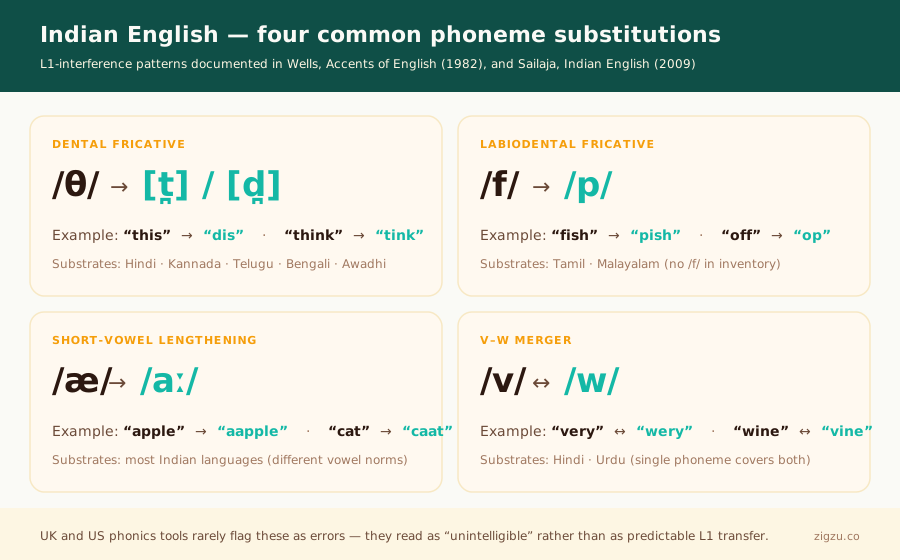
Where Marwari and Dhundari collide with English short vowels
Rajasthani dialects are vowel-rich, but their vowels do not line up neatly with the five short English vowels — so a Jaipur child reading aloud reaches for the closest Marwari or Dhundari sound instead of the English one. The pattern is predictable enough to teach against: once you know which sound a child is reaching for, you know exactly which word it will trip up. These are the four substitutions that surface most often in Jaipur classrooms:
| English sound | Common Jaipur substitution | Example |
|---|---|---|
| Short /æ/ (cat, apple, and) | /ɑː/ (long "aa") | "aapple" for "apple" |
| Short /ʌ/ (cup, umbrella, up) | /ɑ/ or /ʊ/ | "ambrella" for "umbrella" |
| /θ/ (the, this, that, think) | /d/ or /t/ | "dis" for "this", "tank" for "thank" |
| /v/ vs /w/ distinction | Merged as /v/ | "very" and "wary" sound identical |
Neither Hindi nor the Rajasthani dialects carry a dental fricative in their sound inventory, so a Jaipur child reliably reaches for [t̪] or [d̪] when English asks for /θ/ — saying "dis" for "this" and "tank" for "thank" — a pattern documented across the descriptive linguistics of Indian English (Wells, Accents of English, 1982; Sailaja, Indian English, 2009). Marwari speakers add a further wrinkle: the dialect's implosive consonants and its strong tendency to lengthen vowels push the short /æ/ and /ʌ/ even further from their English targets. A child working through a UK phonics app could clear every level and still say "dis" and "aapple" without the programme ever flagging it, because those errors simply do not exist in the British model it was built around.
Your child's Jaipur school teaches the sounds. ZigZu listens while they practise aloud at home.
ZigZu is not a phonics class. It is the daily reading practice layer that works alongside your child's school programme — listening to every word, catching every error, teaching what was missed.
Hears every word your child reads. Teaches what they miss. In Indian English.
Available on Android & iOS · Free to start · No credit card required
Common questions from Jaipur parents about phonics
My child's Jaipur school sends home Jolly Phonics worksheets but doesn't explain the method — what should I do?
Ask the class teacher which Jolly Phonics group they are currently on and what sounds your child should know. Then read our Jolly Phonics India guide — it explains every group and what children should be able to do at each stage. Once you know where your child stands, ten minutes of daily read-aloud at home will significantly accelerate their progress through the remaining groups.
My child speaks Hindi or Rajasthani at home — will that affect their English phonics?
It will create specific, predictable challenges — particularly with the five short English vowels, the 'th' dental fricative, and the v/w distinction. These are not problems with the child's intelligence or language ability; they are gaps between Hindi/Rajasthani and English phoneme inventories. Any good phonics programme addresses them, but it must be calibrated to Indian English — not a UK model that won't recognise Hindi-influenced pronunciation as a distinct error pattern.
My child is in Class 2 in a Jaipur CBSE school and still struggles to read fluently — what should I try first?
For most Class 2 Jaipur children, phonics intervention is the correct first response to reading difficulty. Check quickly: ask your child to read three-letter nonsense words like "zop" or "bim". If they cannot decode them, phonics knowledge is the gap. If they can decode but read slowly, it is a fluency gap — which daily read-aloud practice addresses directly. Ten minutes of daily oral reading with immediate feedback typically produces visible improvement within four to six weeks.
Is English phonics important even if my child will be writing Hindi and Rajasthani alongside English?
Yes — English phonics builds reading accuracy and fluency specifically in English. It does not interfere with Hindi or Rajasthani literacy; in fact, strong phonemic awareness in any language transfers positively to other languages. For Jaipur children aiming for competitive success in English-medium schools and later careers, early phonics grounding from age 4–6 creates a reading foundation that compounds through every subsequent school year.
Frequently asked questions about phonics classes in Jaipur
The strongest phonics options in Jaipur combine systematic sound instruction with daily reading practice. Programmes in Vaishali Nagar and Malviya Nagar teach the 44 English phonemes in structured sequence — the same approach taken by established CBSE and ICSE schools. When choosing a programme, ask whether children read aloud with feedback daily, not just complete worksheets. Daily oral practice is where reading fluency is built.
Private phonics tutors in Jaipur typically charge ₹2,000–₹5,500 per month for weekly sessions. Offline reading centres charge ₹1,500–₹3,500 per month. Online AI coaching, which provides unlimited daily practice, is free to start. Frequency matters more than cost: a child who practises reading aloud for 10 minutes every day progresses significantly faster than one who attends a one-hour weekly session, regardless of how experienced the teacher is.
Both have roles. Offline classes in Jaipur offer direct teacher interaction and structured lesson delivery. Online AI coaching delivers unlimited daily at-home practice — the component that drives reading fluency. The strongest outcomes come from combining both: your child's school teaches phonics sounds in class, and a daily at-home session reinforces them. ZigZu listens to your child read aloud, catches errors in real time, and teaches corrections in Indian English.
Most Jaipur CBSE schools begin phonics in LKG or UKG, when children are 4–5 years old — this is the correct starting age. Children who begin phonics between ages 4 and 6 develop stronger reading by Class 2 than those who start later. If your child is already in Class 1 or 2 without a strong phonics foundation, targeted daily practice will produce measurable improvement within 6–8 weeks.
Jolly Phonics is widely used across Jaipur's English-medium schools. Most established CBSE and ICSE schools in Jaipur run a structured phonics programme. If you are unsure whether your child's school uses Jolly Phonics, ask the class teacher which phonics programme they follow and which sound groups they have completed this term.
Ready to give your Jaipur child daily reading practice at home?
ZigZu listens to every word your child reads aloud and catches the specific errors Jaipur children make — including Hindi vowel substitutions and the 'th' sound.
Start Reading with ZigZuAvailable on Android & iOS · Free to start · No credit card required